LinkedIn feed views up 16%: should you post more?
LinkedIn says feed views are up 16% and daily posters are growing fast. What it means for a small consultant, and a two-week test before you post more.

Part of our LinkedIn comments guide: where to comment, what to write, and how to measure what it earns.
Should you post more on LinkedIn because feed views are up? Not by default. LinkedIn reports more readers in the feed, but also faster growth in people who post every day, so the extra attention is shared among more posts.
For a founder, coach or consultant with a small audience, our reading is that the better answer is to be present where buyers already read: the comment sections. Below is what LinkedIn actually said, what it did not say, and a two-week test you can run without changing your whole routine.
What did LinkedIn say about feed growth on 28 October?
Microsoft reported its quarterly results on 28 October 2026. On the call, CEO Satya Nadella said that across LinkedIn's more than 1.4 billion members, time spent viewing content in the feed was up 15% year over year (a third-party transcript).
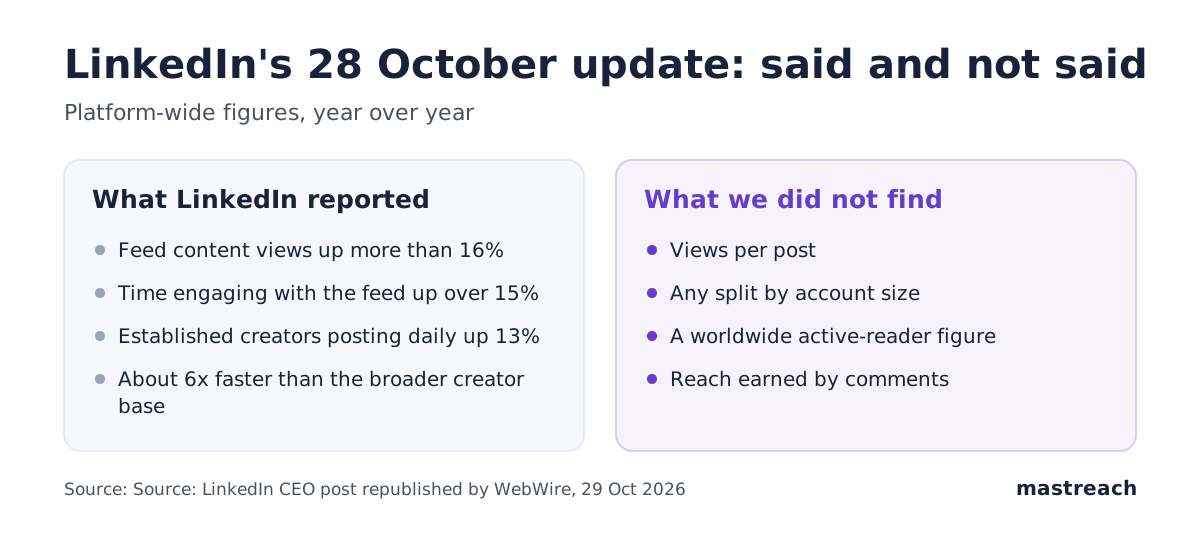
LinkedIn CEO Dan Shapero then shared more detail in a post. In the text republished by WebWire, he wrote that views of content in the feed are "up more than 16% year-over-year". Time spent engaging with it was up over 15%.
These figures are company-wide. They do not say what happened to the typical post, or to a small account.
Why are more people posting daily at the same time?
The same LinkedIn update says "established creators posting daily grew 13%, about 6x faster than the broader creator base." The WebWire text is a republished copy of the LinkedIn post, so we treat it as LinkedIn's wording, not as a separate source.
Our arithmetic: if one group grew 13% and that is six times faster, the wider creator base grew roughly 2%. LinkedIn did not give that number, so treat it as a rough reading.
The sentence matters more than it seems. LinkedIn is describing a platform where people who already post every day are posting even more. If you post once a week, your post sits beside more daily posts than it did a year ago.
Does more feed traffic mean more reach for a small account?
Not necessarily. Feed views up 16% means the total number of times content was seen grew. It does not say how those views are shared out. If daily creators grow fastest, a large share of the new views may go to them.
We can say this carefully. LinkedIn did not publish views per post, or any split by account size. We found no LinkedIn statement that small accounts now reach more people. Anyone who tells you the new numbers mean your posts will travel further is guessing.
If your own numbers have fallen, check them against your usual level first. Our guide to a 4-week check on dropped impressions shows how, before you change what you do.
Members are not active readers: how big is the real audience?
LinkedIn now has more than 1.4 billion members. That is not the number of people reading each month. Social Media Today notes that active use has been around 30% of members, based on the EU figures LinkedIn publishes, which would be about 420 million people. That ratio is the outlet's estimate for the world, not a LinkedIn figure.
So the realistic audience is a few hundred million people, not 1.4 billion. Still huge, and still divided among a growing number of posts.
Should a consultant post more or comment more?
Our reading: comment more, post steadily, and do not try to match daily creators.
A post has to find its own readers. A comment appears in front of the readers of someone else's post. If that post is read by your buyers, your words reach them without you having to win the feed first. We explain the logic in how to choose which posts to comment on.
Here is what our own data shows. Between August and September 2026, people drafted comments in Mastreach, posted them themselves, and the impressions LinkedIn showed under each one added up to 177,931 across 914 comments, about 195 per comment. The founder's own account wrote 284 comments that earned 74,888 impressions over two months, and its followers went from 1,391 to 1,585 in the same period.
Three caveats. Impressions are not unique people: repeat views, and your own views, are counted. We have no post-impression comparison for these accounts, so we cannot say comments beat posts. And follower data exists only for the founder's account, where many things affect followers.
What the data does show is that comments, written by ordinary professionals, were seen. That is why we suggest testing them rather than posting more.

How do you check this on your own account in two weeks?
You do not need a tool to start. A paper table is enough. Here is a test a busy consultant can follow.
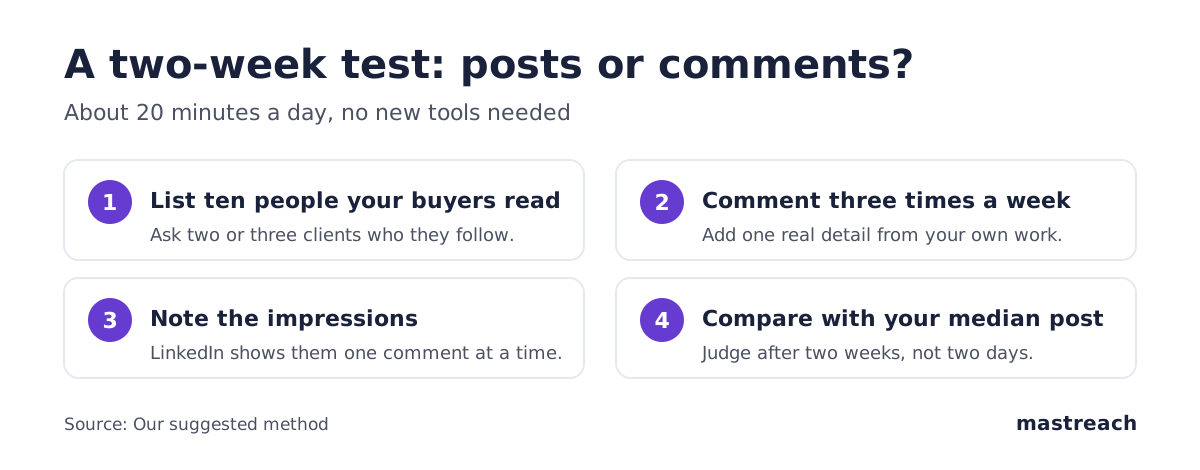
- List ten people your buyers read. Ask two or three clients who they follow. A US agency owner might list a sales trainer and a podcast host. A Dubai property adviser might list a developer and an industry association.
- Comment under their new posts three times a week. Add one real detail from your work: a number, a case, a point that disagrees politely. Type it yourself or edit a draft until it sounds like you.
- Note the impressions under each comment. LinkedIn shows the count one comment at a time. Write it down on the day, with the author and the date.
- Compare with your median post. Take your last ten posts, find the middle number, and compare it with the typical comment. Judge over two weeks, not two days.
Keep posting at your usual pace while you test. The point is to find out where your time earns more, not to stop one thing.
If your posts are not being read past the first lines, LinkedIn's longer post preview test is worth reading too.
Where Mastreach fits
When daily posters crowd the feed, the slow part of commenting is finding the right posts and finding the time. Mastreach is built for that part.
- It shows LinkedIn posts in your subject that your buyers are reading.
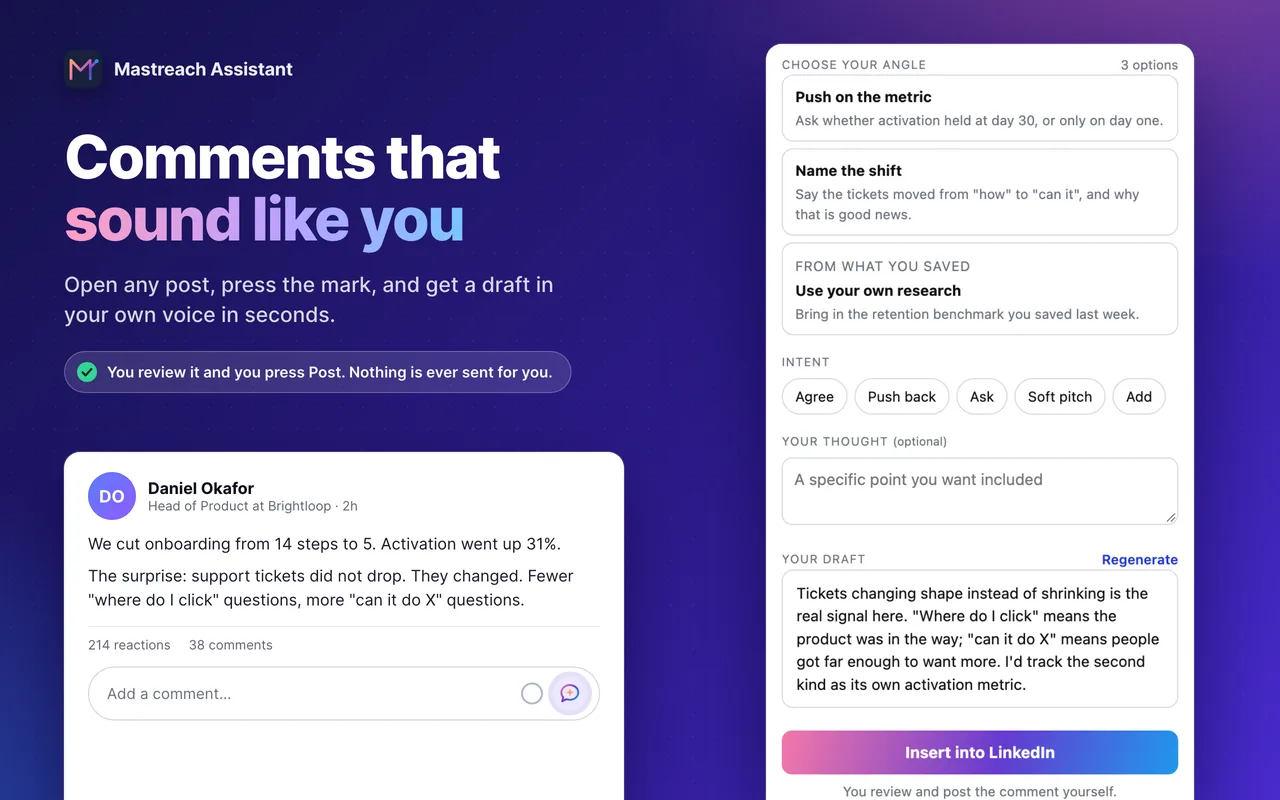
- On any post you pick an angle (push back, ask, add what is missing) and get a draft in your own voice.
- It records the impressions LinkedIn shows under each comment and adds them up by week, so your two-week test is already counted.
You read, edit and post every comment yourself. Nothing is posted for you.
Mastreach has a 5-day free trial, with a card required and nothing charged during the trial.
FAQ
Are LinkedIn feed views really up 16%?
LinkedIn's CEO said views of content in the feed are up more than 16% year over year, in a post republished on 29 October 2026. That is a platform-wide figure. It does not tell you what happened to any single post or account.
Does posting every day increase reach on LinkedIn?
LinkedIn has not said that it does. It reported that established creators who post daily grew 13%, but that is a count of creators, not a finding about reach. Posting more can help some people and tire others, so test it against your own numbers.
How many LinkedIn members actually read the feed?
LinkedIn reports more than 1.4 billion members. Social Media Today estimates about 30% are active, around 420 million, using the EU ratio. LinkedIn has not published a worldwide active figure that we could find.
Should I stop posting and only comment?
We would not. Keep a steady, modest posting pace so people who check your profile after a comment find something. Add comments on posts your buyers read, and let the numbers tell you where to spend more time.
Sources
See what your own comments are reaching.
Mastreach finds the LinkedIn posts your buyers are reading, drafts a comment in your voice, and counts the impressions LinkedIn never adds up for you. You post every comment yourself.
- 914 comments drafted with Mastreach and posted by their owners
- 177,931 LinkedIn impressions on those comments, August to September 2026