LinkedIn impressions dropped? A 4-week check first
Why have your LinkedIn impressions dropped? Use LinkedIn's own analytics and your own baseline to tell noise from a real fall, before you change anything.

Why have your LinkedIn impressions dropped? Most of the time, the honest answer is that you have compared one week with a different week. Before you change anything, check the drop against your own normal, over four weeks, using LinkedIn's own numbers.
This article gives you a simple check that takes about 20 minutes. It works for a US agency owner, a UK consultant, a Dubai firm or an Indian founder alike. It also shows what to do if the drop is real.
What does LinkedIn count as an impression?
An impression is one time your post was shown. LinkedIn's help page on post analytics defines it as the "number of times your post was shown on LinkedIn."
That is not the same as people. The same page lists a separate figure, members reached, which counts distinct members and "does not include repeat views." LinkedIn also says the numbers in post analytics "are estimates and may not be precise."
Two more details from that page matter here:
- Your own views and engagements count towards your analytics.
- Impressions are split into in network (people who follow or are connected to you) and out of network (everyone else).
So a fall in impressions can mean fewer people saw you, or the same people saw you fewer times. Open one post and look at both numbers before you decide anything.
How do you set your own baseline?
Raw impressions tell you almost nothing on their own. Four hundred is a poor result for one person and a good week for another. You need your own yardstick.
Here is the check, step by step.
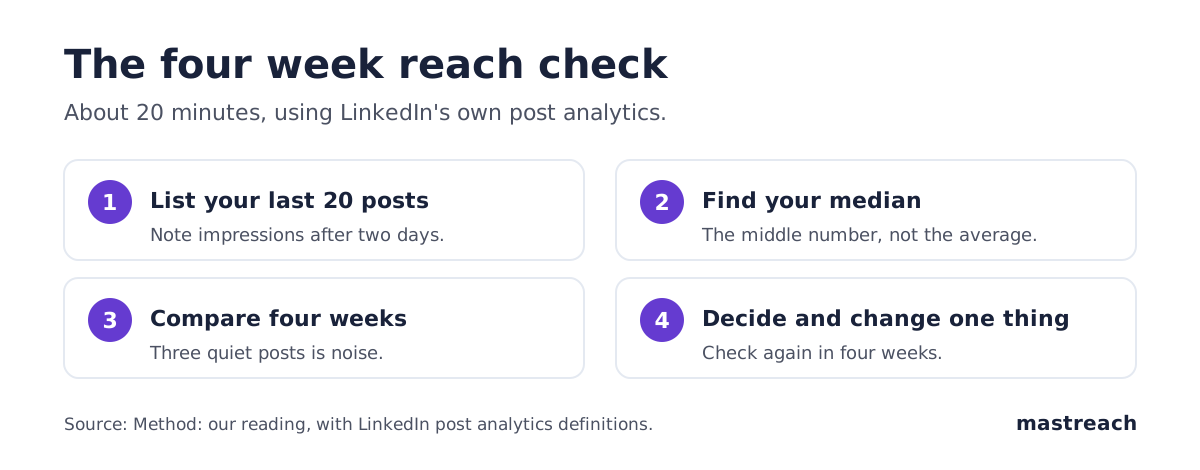
- List your last 20 posts with their impressions. A simple spreadsheet is enough. Wait at least two days after posting before you note a number, because most posts keep collecting views for a while.
- Find the median. Sort the numbers and take the middle one. The median is better than the average, because one lucky post can pull the average up for months.
- Compare four weeks, not three posts. One consultant-focused vendor, Mylance, puts it plainly: "Three quiet posts is noise." A month below your median is the pattern worth acting on. This is one company's advice, not a LinkedIn rule, but it matches our reading.
- Decide. If most posts in four weeks sit below your median, something changed. If two or three did, it is probably noise.
Do not skip step 2. Many people feel a drop because their best post ever is still in their memory.
Is it the algorithm or your last few posts?
Sometimes the platform changes. LinkedIn does adjust its feed, and we track those changes in our note on the 2026 feed changes. But a feed change usually shows up as a fall across many posts, for many people, at the same time.
Ask yourself four questions first:
- Did the last three posts cover one subject, or several? Posts that wander can confuse both your readers and the feed. We wrote about this in why reach stays low when you cover too many topics.
- Did you put a link in the body of the post? Our reading is that this is worth testing on your own account, but LinkedIn does not state a rule, so treat it as an experiment, not a fact.
- Was it a holiday or a slow season? Late summer and late December are quiet in many markets, and the Gulf calendar has its own quiet weeks.
- Did your in-network share change? If your followers still see you but strangers do not, the issue is discovery. If followers see you less, the issue is probably the post itself.
If you cannot tell, change one thing at a time and give it two weeks. Changing five things at once teaches you nothing.
Should you post more when your reach falls?
Usually not. Posting more is the common advice, and it is the one most likely to burn out a busy founder. A fall in reach is a signal to look at what you post and for whom, not only how often.
Mylance says the same: a drop "is not a reason to post more." Again, that is a vendor's view. Our own reading is simpler. If you have 90 minutes a week for LinkedIn, one good post and a handful of useful comments will serve you better than five rushed posts.
How can comments keep you visible in a quiet month?
A comment is shown to the people reading the post it sits under. That means it can reach buyers who have never followed you, and it does not depend on your own posting rhythm.
We have numbers on this. Between August and September 2026, comments drafted in Mastreach and then posted by their owners earned 177,931 impressions across 914 comments, about 195 per comment. These are impressions as LinkedIn shows them under each comment.
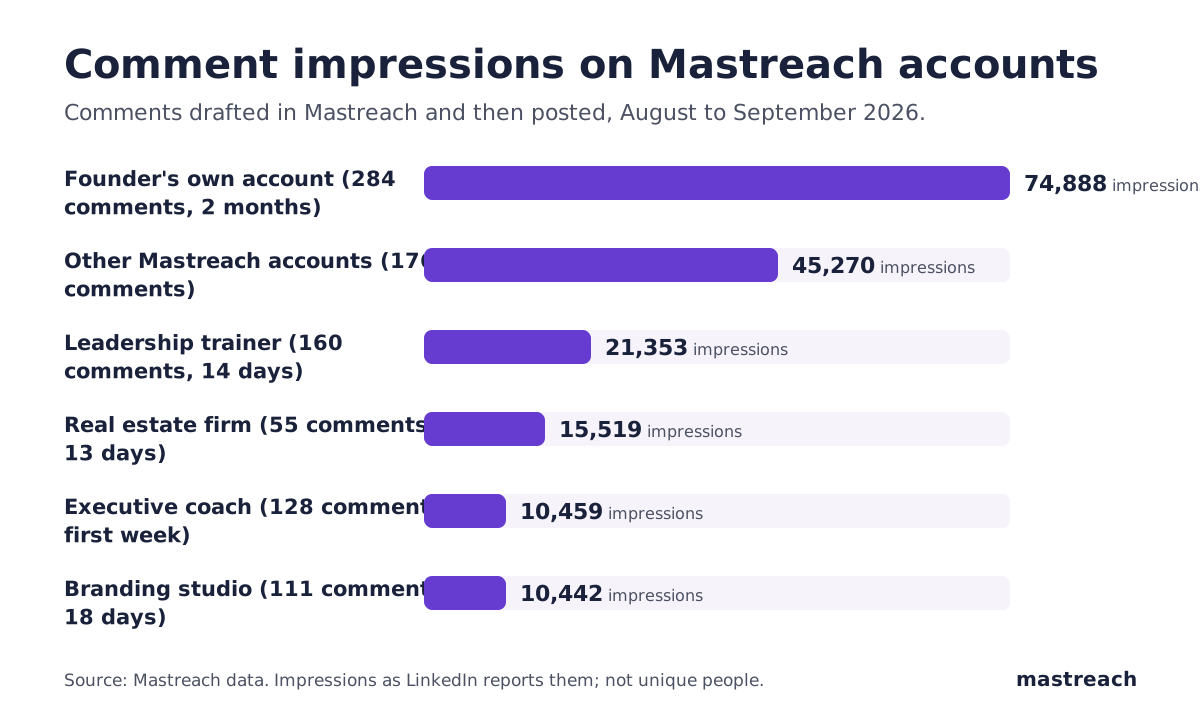
Please read those numbers with care. Impressions are not unique people, because repeat views and your own views count. We have no post-impression comparison for these accounts, so we cannot say comments beat posting for any one person. Follower data exists only for the founder's own account, which grew from 1,391 to 1,585 followers over the same two months.
What the data does show is that comments can add reach in a month when your own posts are quiet. For the full breakdown, see what 914 comments earned and our explainer on comment impressions.
The choice of posts matters more than the number of comments. Start from the people your buyers read, as described in which LinkedIn posts to comment on.

When is a drop a real problem?
Act when all of these are true:
- Four weeks or more sit below your median.
- The fall shows in both in-network and out-of-network impressions.
- You have not changed your subject, your profile or your posting habits in a way that explains it.
Then change one thing. Narrow your subject. Rewrite your headline so a buyer knows what you do. Add two or three comments a day on posts in that subject. Check again in four weeks.
If the numbers recover, keep the change. If not, try the next one. This is slow, but it is the only way to learn what works for your account.
Where Mastreach fits
A quiet month is hard to read because LinkedIn shows comment impressions one comment at a time and totals them nowhere. Mastreach is built for exactly that gap.
- It shows the LinkedIn posts in your subject that your buyers are reading.
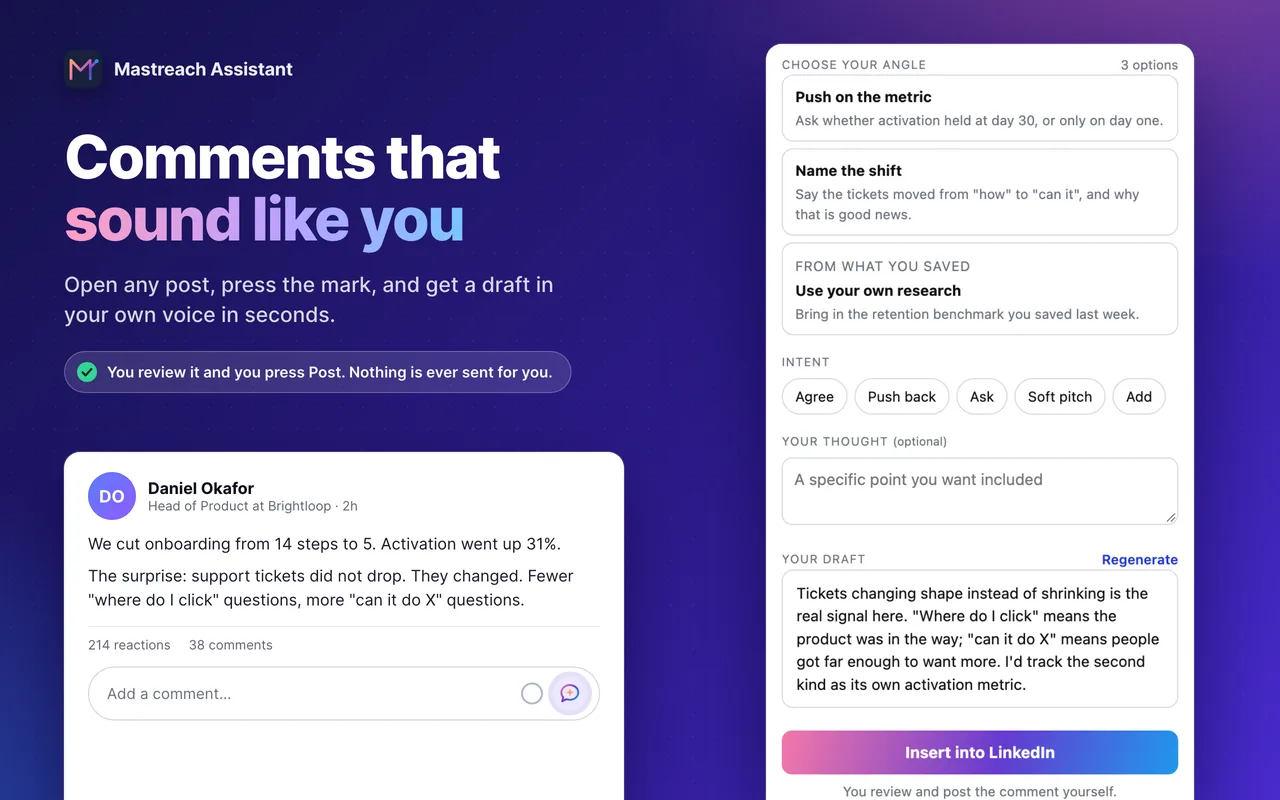
- It drafts a comment in your own voice, from an angle you pick.
- It records the impressions LinkedIn shows under each comment and adds them up by week.
You read, edit and post every comment yourself. Mastreach never posts, comments or messages for you.
Try it free for 5 days. Plans start at $29 a month at the founding price.
FAQ
Why have my LinkedIn impressions dropped?
Most often it is noise or a quiet season. Compare your last four weeks with the median of your last 20 posts. If most posts sit below it, look at your subject, your format and your in-network versus out-of-network split.
Are LinkedIn impressions the same as people reached?
No. Impressions count every time a post is shown, including repeat views and your own. LinkedIn lists members reached separately and says it excludes repeat views. Both are estimates, according to LinkedIn.
Should I post more if my reach falls?
Not as a first step. First find out whether the fall is real. If it is, narrow your subject and add a few useful comments on posts your buyers read, before you add more posts.
How long should I wait before judging a post?
Wait at least two days. A vendor guide suggests 48 hours, and our reading is that this is reasonable, because LinkedIn analytics keep updating as people view the post.
Sources
See what your own comments are reaching.
Mastreach finds the LinkedIn posts your buyers are reading, drafts a comment in your voice, and counts the impressions LinkedIn never adds up for you. You post every comment yourself.
- 914 comments drafted with Mastreach and posted by their owners
- 177,931 LinkedIn impressions on those comments, August to September 2026