LinkedIn profile search ranking: why it differs
Your LinkedIn search rank looks different to every buyer. What LinkedIn Help says decides people search, and what to measure and change instead.

Your LinkedIn search rank is different for every person who looks, so the position you see for yourself tells you very little. LinkedIn Help says people search results follow an order "unique to each member", based on the query and the searcher's own context.
Many owners still type their job title into LinkedIn, find themselves on page three, and feel worried. Or they find themselves at number two and feel safe. Neither feeling is reliable. This article explains what LinkedIn says decides the order, how buyers now search, and what to measure and change instead.
Why does my LinkedIn search rank look different from my client's?
Because LinkedIn does not keep one fixed list for everyone. Its Help page on people search says LinkedIn "uses proprietary relevance algorithms to generate a results order that's unique to each member". The same search can look different for different people.
Think of three people looking at one shelf of books, each sorted by what that person has read before. The books are the same. The order is not.
A consultant in London, a buyer in Dubai and a friend in Pune can all type the same words and see different results. If you check your own rank, you see a list shaped by your own network and activity. A buyer you have never met sees a different one.
What does LinkedIn say decides people search results?
LinkedIn names several things that can influence the order. From the same Help page:
- Your profile and activity on LinkedIn (the searcher's own)
- Your connections and network
- Other members' behaviour in similar searches
- The searcher's past search history
LinkedIn does not publish the weights, and nobody outside LinkedIn knows them. Be wary of any guide that claims an exact formula.
One line from the page matters most for the "I tested myself" habit. Because results are personalised, LinkedIn says testing a query "using a small number of accounts usually won't represent" how a profile appears across the millions of searches run each day. A test from your own account, your partner's account and your assistant's account is still a small number.
Our reading: your rank is a poor number to chase because it is not one number. It is a different number for each buyer.
How do buyers search on LinkedIn now?
Increasingly, in full sentences. LinkedIn's Help page on searching for people describes an AI-powered people search that can "understand the meaning behind your query, not just exact keywords". Its examples include "Career coaches who can help with public speaking" and "Finance leaders at nonprofits in Boston".
LinkedIn's engineering team says the same in a January 2026 post on its search stack. Its newer search uses large language models and "interprets natural language to infer user goals". The post is about how the system is built, and it describes people search and job search together. It does not tell members how to rank.
What does this mean for you? A buyer may type what they need, not your job title. A UK finance director might write "fractional CFO for a 40-person manufacturer". A Dubai founder might write "business coach for family companies". A US agency owner might write "someone to fix our sales process".
The practical lesson is to describe, in your profile, the problem you solve and the people you solve it for. Do it in the plain words a buyer would use. We covered how buyers now ask AI tools the same sort of question in how buyers find consultants with AI.
Does adding more keywords to my profile help?
Not by itself. LinkedIn says so directly: adding more keywords "doesn't automatically improve your appearance in search results". It recommends keywords that "accurately reflect your expertise and experience" and warns against "keyword stuffing".
It goes further. LinkedIn says a profile that looks overly optimised may be affected by spam detection systems, which can hurt visibility in search.
So do not paste twenty job titles into your headline. A profile that reads like a list of search terms is also a poor sales page for a human. The buyer who does find you will leave.
A sensible profile says three things in plain sentences:
- Who you help. "Founders of 10 to 50 person B2B firms."
- What problem you solve. "Their sales depend on the owner."
- What you do about it. "I set up a simple, repeatable way to win the next client."
If you want a longer guide to staying focused on one subject, see why your LinkedIn reach is low when you cover too many topics.
What should I measure instead of my rank?
LinkedIn gives one answer. Since search results vary by person, it says a more helpful indicator of how visible your profile is can be "the number of views your profile receives", which you can see in the Who's Viewed Your Profile section.
Profile views are not perfect. They include people who are not buyers, and free accounts see limited detail. But the count moves when more of the right people notice you, and it does not depend on one person's search.
Here is a simple comparison.
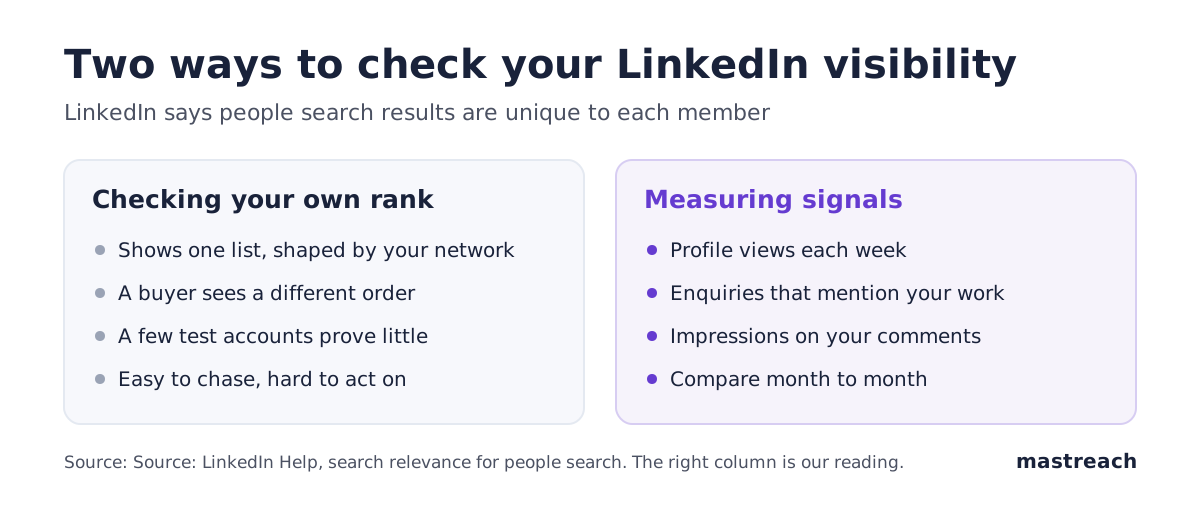
Write the numbers in a notebook once a week, on the same day. Three figures are enough:
- Profile views for the week.
- New enquiries or conversations that mention something you wrote.
- Impressions on your recent comments.
Look at the trend over a month, not the daily wobble.
How do comments feed the profile views that matter?
A comment puts your name and photo in front of people who are already reading about your subject. Some of them click your name. That click is a profile view from someone interested, which is more useful than an anonymous search hit.
This is our reading, not a LinkedIn statement. LinkedIn does not say that comments raise search position, and we do not claim they do. We are saying that comments create attention you can count.
Here is what our own data shows, with caveats. Across 914 comments drafted in Mastreach and then posted (August to September 2026), accounts earned 177,931 impressions, about 195 per comment. The founder's own account had 284 comments and 74,888 impressions over two months, and its followers went from 1,391 to 1,585 in the same period.
Impressions are not unique people, and repeat views and your own views count. We have no comparison with how these accounts did before. The follower figure is from one account only. So read this as a sign that steady commenting gets seen, not as proof that it brings clients or lifts your search position.
If you have no list of people to comment on yet, our guide to building a list of 30 buyers to comment on takes about two hours.
What can I change this week?
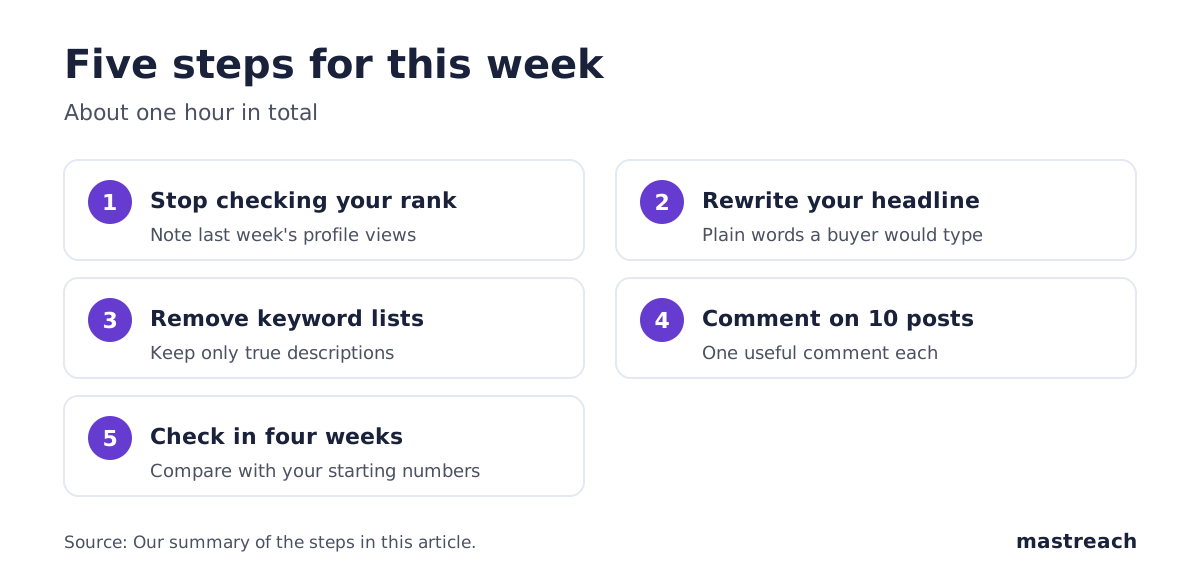
Five steps, about an hour in total.
- Stop checking your own rank. Write down your profile views for last week as your starting number.
- Rewrite your headline and About opening in the plain words a buyer would type. Say who you help and what problem you solve.
- Remove keyword lists. Keep only terms that truly describe your work.
- Choose 10 buyers or buyer-readers and leave one useful comment on a recent post by each, in your own words.
- Check in four weeks. Compare profile views and comment impressions with your starting numbers.
If a buyer asks how they found you, write down the answer. That one sentence is worth more than a rank.
Where Mastreach fits
Search rank cannot be fixed, because it differs for every buyer. What you can do is be seen by the right people, and count it. Mastreach is a LinkedIn assistant built for that.
- It shows posts in your subject that your buyers are reading.
- On any post, you pick an angle and get a comment draft in your own voice, which you edit.
- It records the impression count LinkedIn shows under each comment and totals them by week.
You read, edit and post every comment yourself. Mastreach never posts, comments, connects or messages for you.
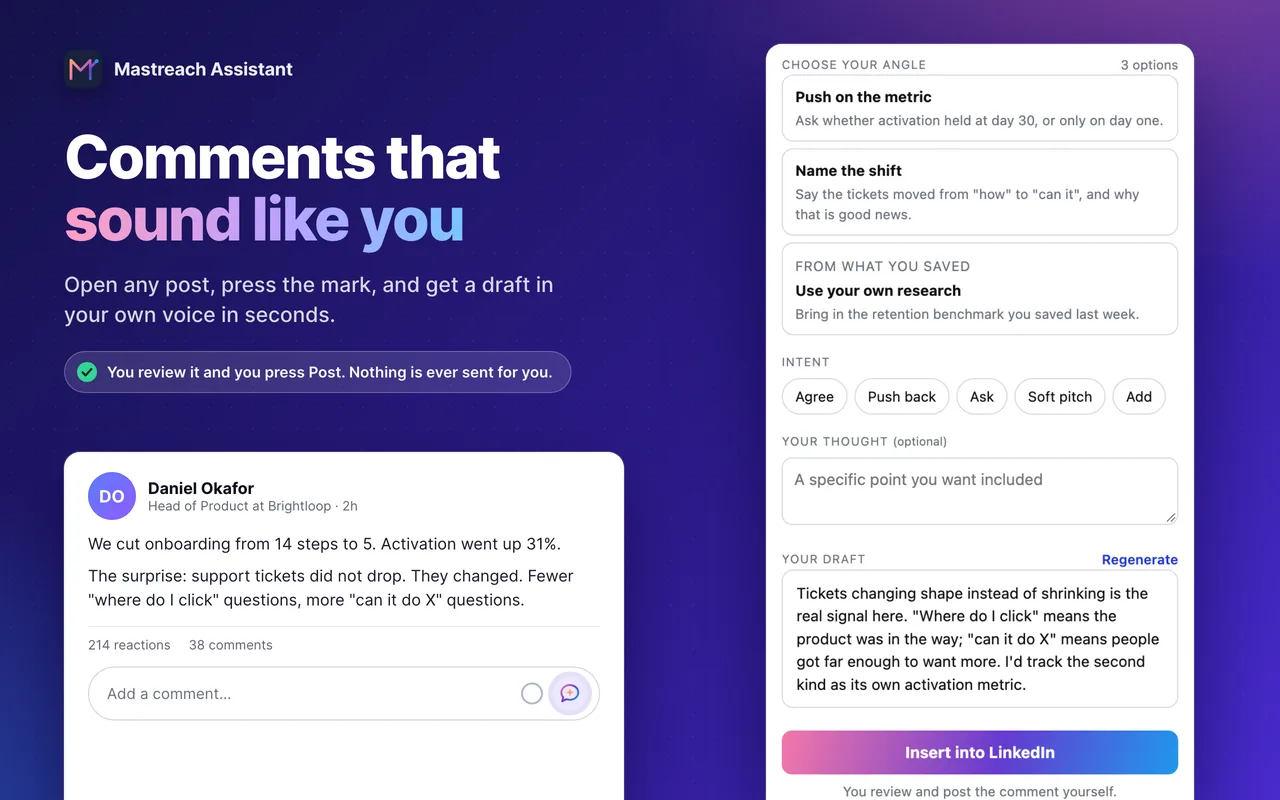
You can try it free for 5 days. A card is required and nothing is charged during the trial.
FAQ
Can I check my LinkedIn search ranking?
You can search for yourself, but the result is only what your own account sees. LinkedIn says results are unique to each member, so it is not what a buyer sees. Use profile views as your visibility measure instead.
Do more keywords improve my LinkedIn search position?
LinkedIn says no, not automatically. It advises accurate keywords that reflect your real expertise, and warns that a profile that looks overly optimised may be affected by spam detection.
Does LinkedIn search understand full sentences?
Yes. LinkedIn Help describes an AI-powered people search that can understand the meaning of a query, with examples such as "Career coaches who can help with public speaking". Write your profile in the plain words a buyer would use.
Do comments raise my LinkedIn search rank?
LinkedIn has not said so. Comments do put your name in front of people interested in your subject, and you can count the impressions they earn. Treat that as visibility you can measure, not as a ranking trick.
Sources
See what your own comments are reaching.
Mastreach finds the LinkedIn posts your buyers are reading, drafts a comment in your voice, and counts the impressions LinkedIn never adds up for you. You post every comment yourself.
- 914 comments drafted with Mastreach and posted by their owners
- 177,931 LinkedIn impressions on those comments, August to September 2026