LinkedIn engagement list: 30 buyers to comment on
Build a LinkedIn engagement list of 30 buyers in two hours: who to include, how to find them with a small network, and a 30-minute weekly routine.
Part of our LinkedIn comments guide: where to comment, what to write, and how to measure what it earns.
A LinkedIn engagement list is a short list of people whose posts you comment on every week. For a consultant, coach or founder, 30 names is a good size: enough to always have something fresh to read, few enough to know each person.
The idea is simple. Instead of commenting on whatever your feed shows, you choose who you want to be known by, and you turn up in their comment sections again and again. This article shows who belongs on the list, how to find them when your network is small, and a weekly routine that takes about 30 minutes.
Why does a short list beat commenting on whatever is in your feed?
Because buyers notice repeat names. One good comment is easy to forget. The same thoughtful person appearing under a buyer's posts four weeks in a row is not.
Your feed is also a poor guide to where your clients are. We wrote about this in which LinkedIn posts to comment on: the feed shows what you have clicked before, not what your buyers read.
The coaching platform Paperbell, in a vendor blog, advises building an engagement list of 20 to 50 people and tracking it in a simple spreadsheet. Its goal is to become "a familiar, thoughtful voice" before you ever send a message. That is a company's advice, not a LinkedIn rule. It matches what we see in our own work.
Who belongs on your LinkedIn engagement list?
Three kinds of people, in roughly these amounts:
- Ten likely buyers. Owners, directors and managers who could hire you, or who have hired someone like you.
- Fifteen people your buyers read. Industry voices, association leaders, newsletter writers, authors. Their comment sections are where your buyers gather.
- Five peers who sell next to you. A tax adviser if you are a business coach, for example. They can refer work to you. Choose partners, not rivals.
Who does not belong? Other people who do your job. A founder in Austin who writes about growth will attract other founders. In an October 2026 Inc. column, communications coach Hayley Wahlbeck warns that a consultant writing about content strategy "might attract other consultants". Their enthusiasm, she says, does not establish demand for your services. The same trap applies to your list. Friendly peers are pleasant, but they rarely pay.
How do you find 30 buyers when your network is small?
You do not need a big network. You need a few good starting points. Use these four.
- Start with people you know. Open your last ten clients and enquiries. Add the ones who post, plus anyone like them.
- Look at what your clients read. Open a good client's profile and check their recent activity. Note whose posts they comment on.
- Read the comment sections of your clients' posts. Senior people who comment there often share your buyers' audience.
- Ask. "Who do you follow on LinkedIn for [your subject]?" Most people give three names at once.
Here are three examples. A UK HR consultant lists ten finance directors at mid-size firms and the heads of two regional trade bodies. A Dubai property adviser adds local developers' leaders and three lawyers who advise overseas buyers. A founder in Pune who sells software to US logistics firms lists operations managers and two logistics newsletter writers.
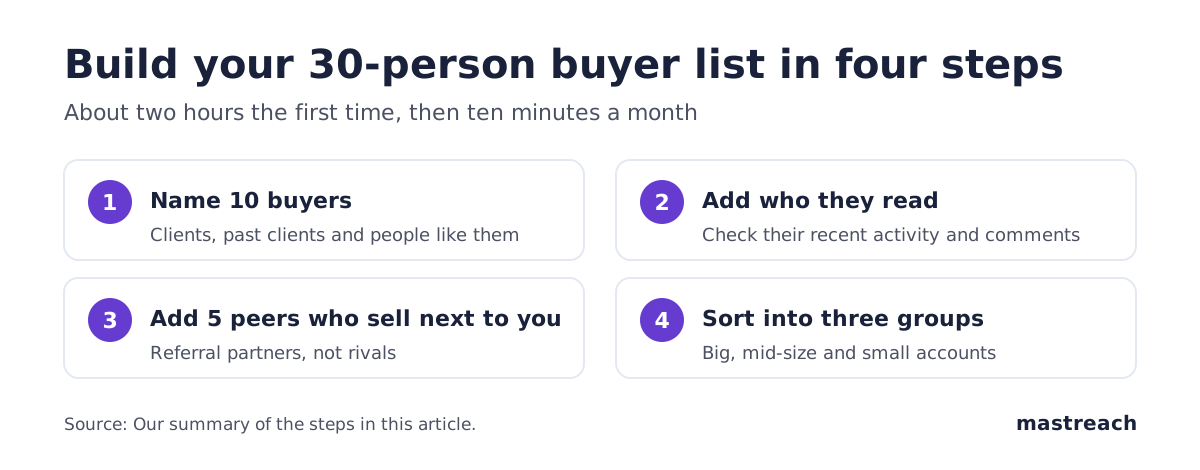
Keep the list in a plain spreadsheet with four columns: name, group (big, mid, small), what they post about, and the date you last commented.
How do you split the list between big, mid-size and small accounts?
Aim for roughly a third in each group.
- Big accounts have large audiences. A comment can be seen by many people, but yours sits among hundreds. They are worth a place only if your buyers truly read them.
- Mid-size accounts are usually the sweet spot: a real audience of the right people, and an author who may notice you.
- Small accounts are often your buyers themselves. A comment here can start a real conversation.
Our reading is that size matters less than who is reading. A small account with a tight subject can reach more of your buyers than a famous one. We have not measured this by account size, so treat it as a working view.
What does a weekly routine with the list look like?
Keep it light enough that you will actually do it. A routine that takes 30 minutes a week beats a plan that needs two hours and dies in week three.

- Monday, 10 minutes: scan the list for fresh posts. Pick three to five where you can add one real detail from your own work.
- Tuesday to Thursday, 5 minutes each: write and post your comments. Read the post first. Add something only you would know: a number, a client lesson, a respectful disagreement.
- Friday, 5 minutes: update the spreadsheet. Note who replied, who visited your profile, and anyone who seems ready for a conversation.
Rotate through the list so every name gets a comment about once every two to three weeks. That is often enough to be recognised without feeling pushy. On pace, see how many comments a day is safe: LinkedIn publishes no daily number, and a few thoughtful comments is a sensible pace. Write each one yourself, or edit any draft until it sounds like you.
When is it time to move from comments to a message?
When the other person has noticed you. Signs include a reply to your comment, a like on several of your comments, a connection request from them, or a visit to your profile.
Then continue the exact topic you discussed. Marketing firm Scripe, in its own blog, puts it well: a comment thread is "the most natural on-ramp" to a private conversation, and "I wrote about exactly that last month, want me to send it?" is a conversation, while a cold pitch is not. For more on the order of events, see comment before connecting.
Do not rush. Many of your 30 are not buying this year. Scripe cites the "95-5 rule" from the Ehrenberg-Bass Institute: only about 5 percent of buyers are in the market at any moment. The list keeps you known by the other 95 percent, so you are the name they remember when they are ready.
How do you check that the list is working?
Look once a month, not daily. Ask four questions.
- Which names replied or visited my profile?
- Which comments earned the most impressions?
- Did any enquiry mention a comment or a name on my list?
- Who should I add or drop?
LinkedIn shows the impressions for each comment one at a time. Add them up yourself in the spreadsheet, or use a tool that does.
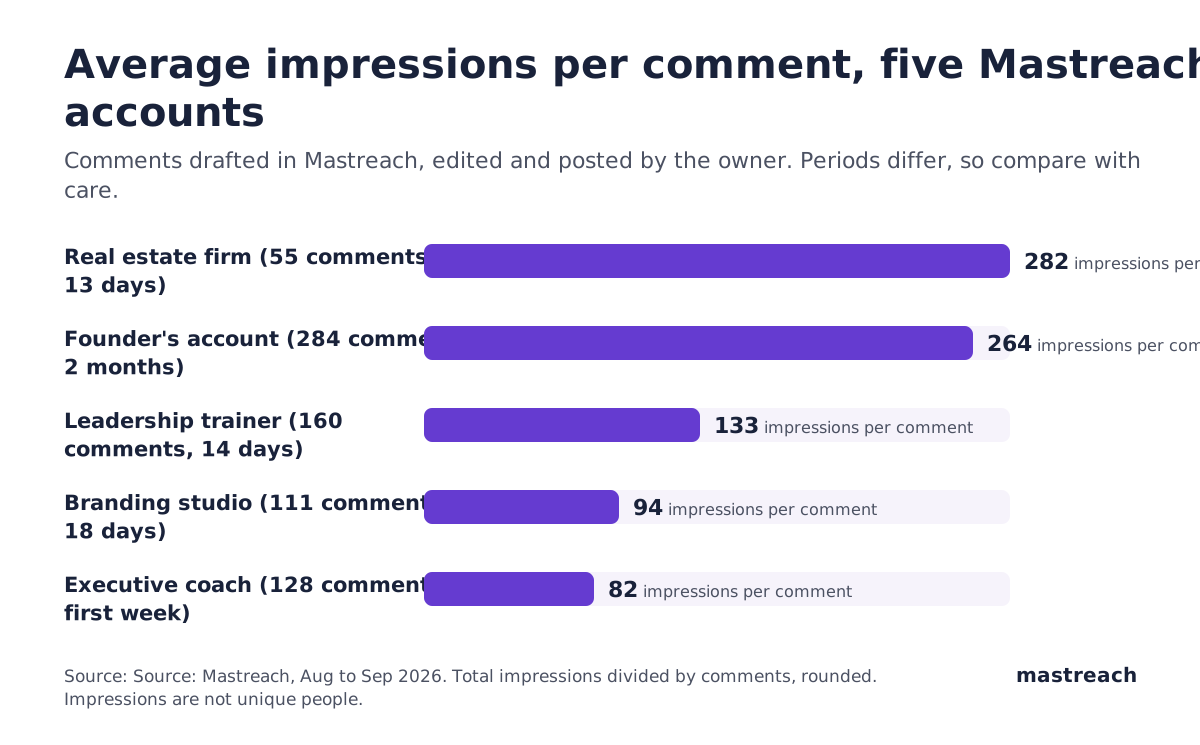
Here is what our own data shows, with caveats. Across 914 comments drafted in Mastreach and then posted (August to September 2026), accounts earned 177,931 impressions, about 195 per comment. The founder's own account had 284 comments and 74,888 impressions over two months, and its followers went from 1,391 to 1,585 in the same period. Impressions are not unique people, repeat views and your own views count, and we have no comparison with how these accounts did before. The follower figure comes from one account only. So this is a sign that steady commenting is seen, not proof it wins clients.
Where Mastreach fits
An engagement list only works if you keep it fresh and can see what it earns. Mastreach is a LinkedIn assistant built for that routine.
- It shows posts in your subject that your buyers are reading, so your list never goes stale.
- On any post, you pick an angle and get a comment draft in your own voice, which you edit.
- It records the impressions under each comment and totals them by week, with the posts and authors that brought the most reach.
You read, edit and post every comment yourself. Mastreach never posts, comments, connects or messages for you.
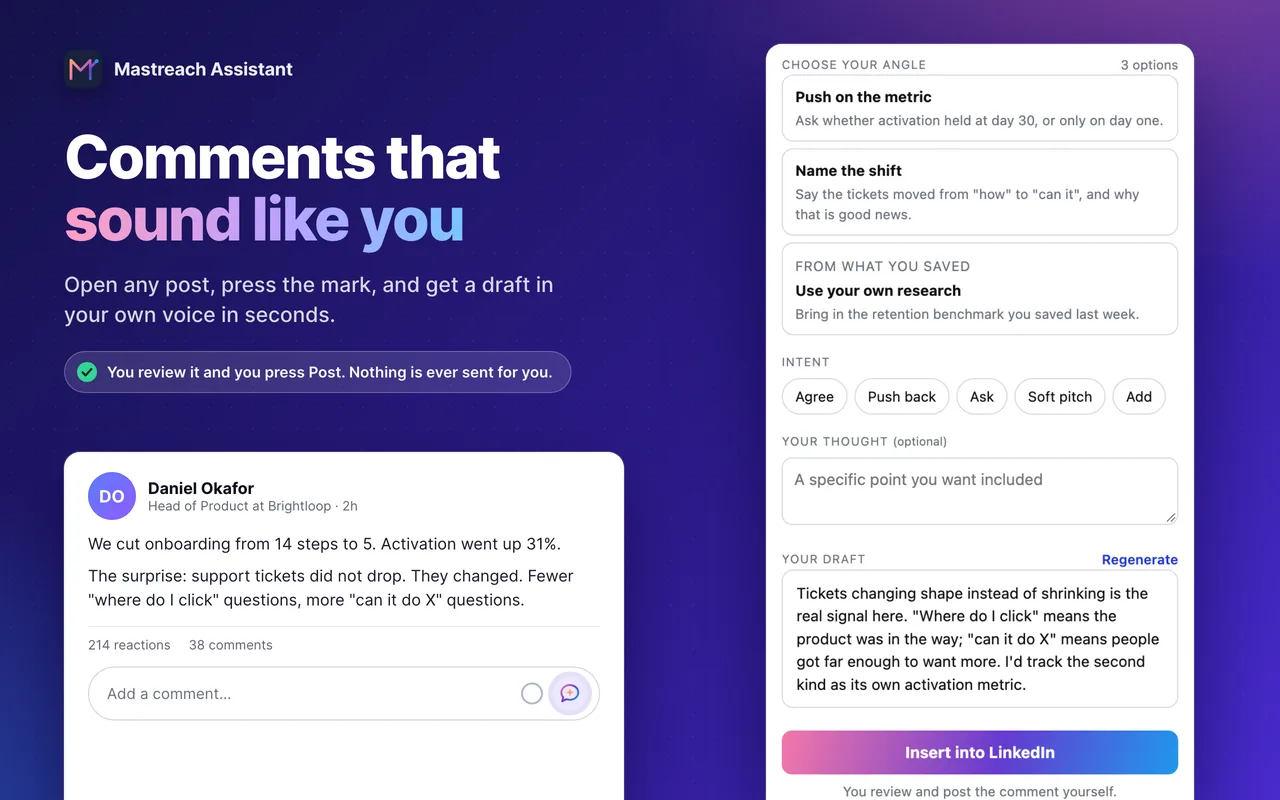
You can try it free for 5 days, with a card required and nothing charged during the trial. Plans start from $29 a month.
FAQ
How many people should be on a LinkedIn engagement list?
Between 20 and 50 is common advice, and 30 is a good place to start. It is long enough that you always find a fresh post, and short enough that you recognise each person.
How often should I comment on people on my list?
About once every two to three weeks for each person, with three to five comments a week in total. Spread them out rather than commenting on one person many times in a day.
Should I include my competitors?
Include friendly peers who sell something next to yours, since they can refer clients. Direct rivals are a poor use of a slot, because their readers are not necessarily your buyers.
Is it fine to use AI to draft the comments?
Yes, if you read the post, edit the draft until it sounds like you, and post it yourself. Comments that are posted unedited tend to read the same as everyone else's.
Sources
See what your own comments are reaching.
Mastreach finds the LinkedIn posts your buyers are reading, drafts a comment in your voice, and counts the impressions LinkedIn never adds up for you. You post every comment yourself.
- 914 comments drafted with Mastreach and posted by their owners
- 177,931 LinkedIn impressions on those comments, August to September 2026