How long should a LinkedIn comment be? What data says
The "15 words" rule is repeated everywhere but cannot be checked. What open studies show about comment length, and a simple rule you can use tomorrow.

Part of our LinkedIn comments guide: where to comment, what to write, and how to measure what it earns.
A good LinkedIn comment is one specific point, written in one to three sentences. That is usually 20 to 50 words, but length is not what makes it work.
You will often read that comments must have more than 15 words. We looked for where that number comes from, and what open studies say. The honest answer is that nobody outside LinkedIn can prove it.
Where does the "15 words" rule come from?
It comes from Richard van der Blom, a LinkedIn analyst in Europe who sells an annual paid report on how the feed behaves. The claim is repeated by many other blogs.
The number has moved over time. A 2024 write-up of one of his webinars said comments over 15 words had "double the impact". In April 2025 he wrote that a good comment is 20+ words. In February 2026 he wrote that comments of 15 or more words boost reach 2.5x more than short replies.
Three versions of one rule: "double", "20+ words" and "2.5x". The full data sits behind a paywall, and we have not seen LinkedIn confirm any of it. Our reading: treat 15 words as a sensible floor, not a law. A comment that says "Great post, thanks for sharing" fails because it says nothing, not because it is short.
What do open studies say about comment length?
We found two open sources. Both are small and both have limits.
A vendor study. Linqin, a company that sells commenting software, analysed 16,000 of its own comments. Comments under 40 words had the best reply rate, 17.1%, and 16.2% of all comments earned any reply. This measures replies, not reach, and it covers comments made by one product.
A one-person test. Michelle Martin at Hootsuite ran a two-week experiment in 2024. She posted 40 short, generic comments in week one and 40 longer, personal ones in week two.
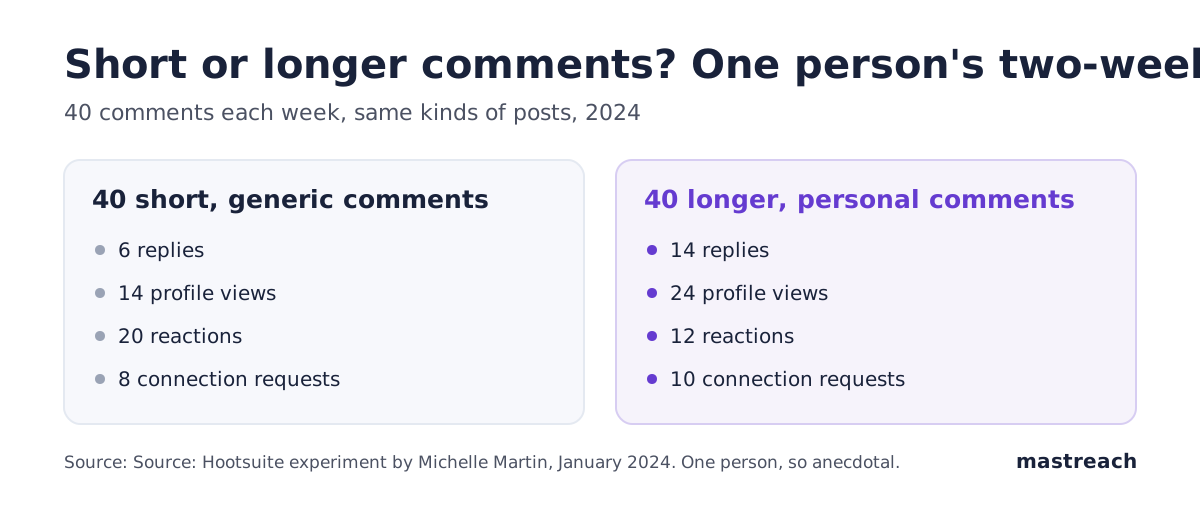
Longer comments won on replies and profile views. Short ones won on reactions. Hootsuite's own conclusion was that short comments can still bring a similar result with much less effort, as long as they are relevant.
Put the two together and the pattern is plain: specific beats long, and short can work when it is specific.
Does a longer comment earn more impressions in our data?
We cannot say yet. Mastreach does record the impressions LinkedIn shows under each comment, but we have not split them by comment length, so we will not guess.
What we can say is limited. Across 914 comments drafted in Mastreach and then posted, LinkedIn showed 177,931 impressions, about 195 per comment. These are impressions, not unique people. Repeat views and the author's own views count. Reach also depends far more on which post you comment under than on how many words you use.
That fits what we see in practice: a comment under a post many of your buyers are reading is seen more than a perfect long comment under a post nobody opens. If you are still choosing where to comment, start with which LinkedIn posts to comment on.

When is a short comment the right choice?
Short is right when you have one clear thing to add and nothing more. Three cases:
- A fact the post missed. "In the UK the same rule applies from April, not January." One sentence.
- A real question. A sharp question that shows you read the post can earn a reply from the author.
- A quick, honest agreement with a reason. Not "So true!" but "So true. We lost two Dubai clients the same way."
Short is wrong when it is a reflex. Comments such as "Love this!" are exactly what readers now spot as filler. We cover the signs in how to spot AI slop in LinkedIn comments.
When should a comment be longer?
Go longer when you have a short story or a worked example that the post's readers would value. A consultant in Sydney might add two sentences on what happened when a client tried the same approach. A founder in Mumbai might add the one number that changed their mind.
Stop when the point is made. In our experience, past about 80 words a comment starts to read like a small post that few people finish. If you have that much to say, write a post instead.
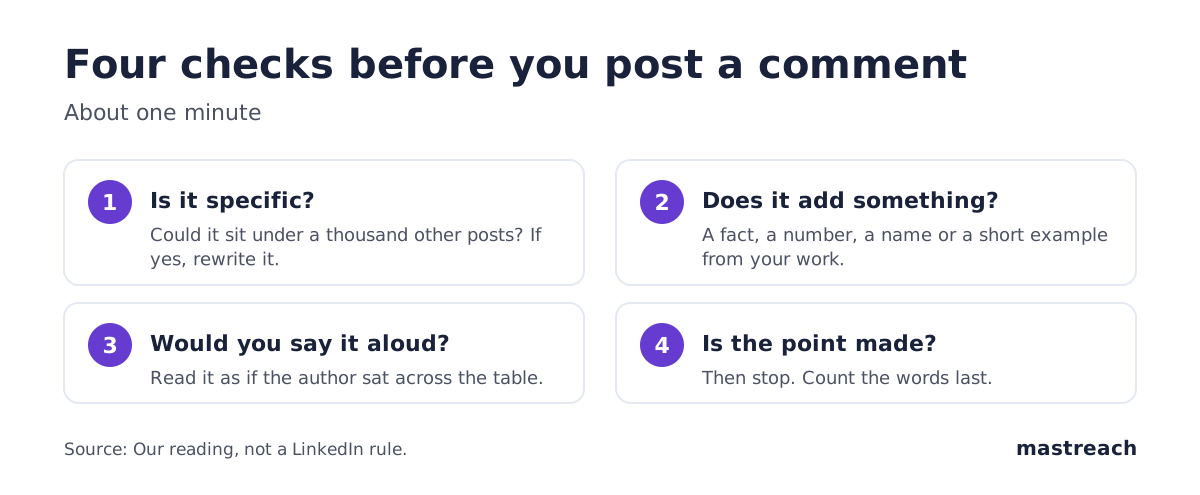
A simple check before you post
Run every comment through these four steps. It takes under a minute.
If you want a way to find the right posts first, the method in the engagement list for buyers takes about 30 minutes to set up.
How do you keep a comment in your own voice at any length?
Read it aloud. If you would not say it to the author over coffee, change it. Cut any opening that could sit under a thousand other posts. Replace one general word with a name, a number or a place from your own work.
The same applies to AI help. A draft is a starting point. LinkedIn has even started flagging posts that seem like AI, so readers are watching for it too.
Where Mastreach fits
Choosing a length is easy once you know what you want to say. Finding the right post and a first draft is the slow part. Mastreach is a LinkedIn assistant for founders, coaches and consultants.
- It shows posts in your subject that your buyers are reading.
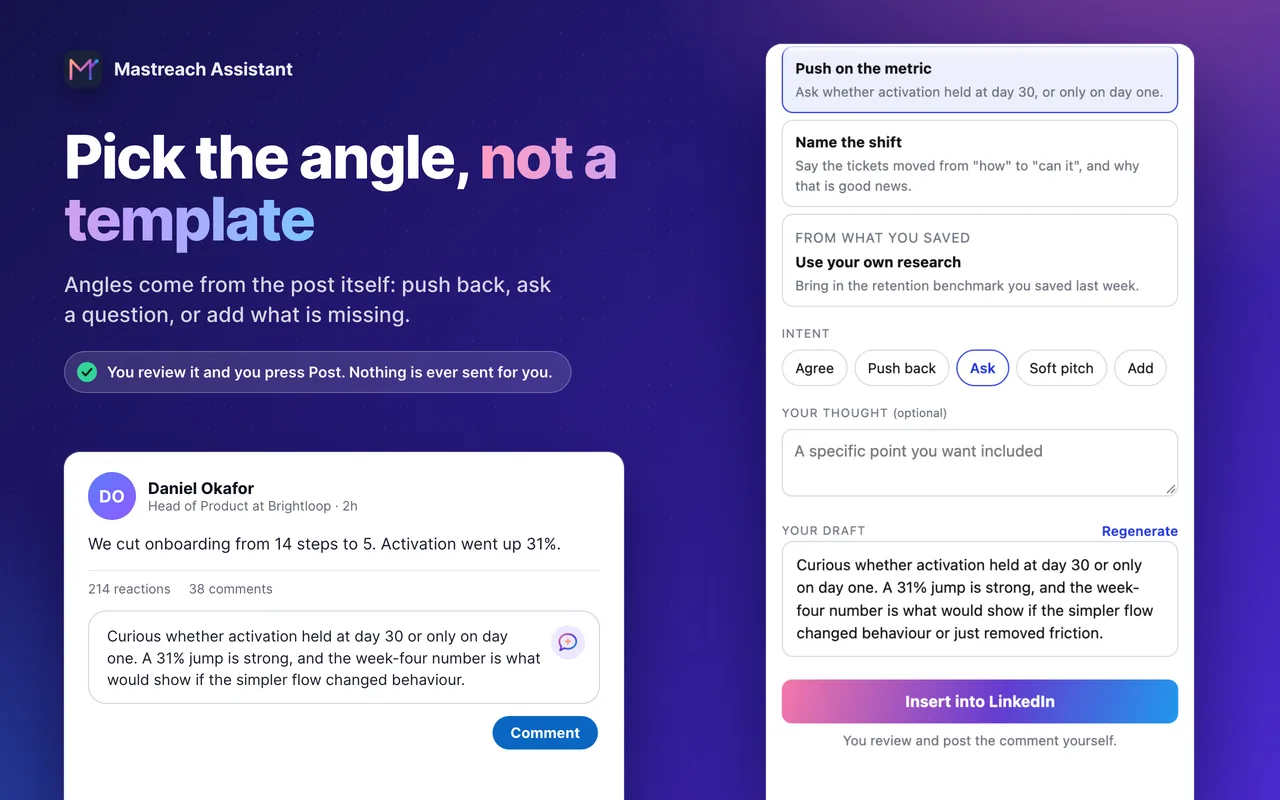
- On any post, you pick an angle (push back, ask, add what is missing) and get a draft in your own voice.
- It records the impressions LinkedIn shows under each comment and adds them up, so you can see which kinds of comment travel.
You read, edit and post every comment yourself. Nothing is posted for you.
Plans start at $29 a month, and the 5-day free trial lets you try it before anything is charged.
FAQ
Is a one-word LinkedIn comment bad?
It rarely helps. A one-word comment adds nothing for readers and gives the author no reason to reply. In Hootsuite's small test, very short comments still brought some reactions, but they are not how you build trust with buyers.
Does LinkedIn count words in comments?
LinkedIn has not said so in anything we found. The "15 words" rule comes from a paid third-party report, and we could not check it. Treat it as a guide to writing something substantive.
How many sentences should a LinkedIn comment have?
One to three works for most comments. Make one point, back it with a fact or short example, and stop. If you need more room, the point is probably a post of its own.
Should I end a comment with a question?
Only when you truly want the answer. In Linqin's vendor study, comments on posts that ask a question had the best chance of a reply, 25.1%. That is a statement about the post, not proof that your own closing question helps.
Sources
- Law Firm Marketing Club: 10 learnings from Richard van der Blom's LinkedIn webinar (2024)
- Richard van der Blom on LinkedIn, April 2025
- Richard van der Blom on LinkedIn, February 2026
- Linqin: LinkedIn Comments study, 16,000 comments (June 2026)
- Hootsuite: Do longer LinkedIn comments drive more connection requests? (2024)
See what your own comments are reaching.
Mastreach finds the LinkedIn posts your buyers are reading, drafts a comment in your voice, and counts the impressions LinkedIn never adds up for you. You post every comment yourself.
- 914 comments drafted with Mastreach and posted by their owners
- 177,931 LinkedIn impressions on those comments, August to September 2026