Which LinkedIn posts to comment on: a buyer-first method
Which LinkedIn posts should a consultant comment on? Start from the people your buyers read, not your feed. A simple method for busy founders and coaches.

Part of our LinkedIn comments guide: where to comment, what to write, and how to measure what it earns.
Which LinkedIn posts should you comment on? The ones your buyers are reading, written by people they follow, posted recently, where you can add one real detail from your own work. Your feed is a poor guide, because it shows what you have clicked before, not what your clients read.
This article gives a method a busy consultant, coach or founder can start tomorrow. It takes about an hour to set up and about 20 minutes, three times a week, to run.
Why is your feed the wrong place to look for posts?
LinkedIn's feed is built around your own habits. If you have liked posts about marketing tips, you will see more of them. That is fine for learning. It is a weak way to find your clients.
The vendor Chime, which sells LinkedIn services to B2B firms, makes the same point: the feed shows what you are likely to engage with, "which is not the same thing as posts your ideal buyers are reading". This is a company's view, not a LinkedIn statement. But it matches what we see in our own work.
Think of a UK financial adviser who scrolls for 30 minutes each morning and comments on whatever looks friendly. She meets other advisers. Her future clients, business owners aged 50, are reading other people entirely.
Whose posts do your buyers read, and how do you find out?
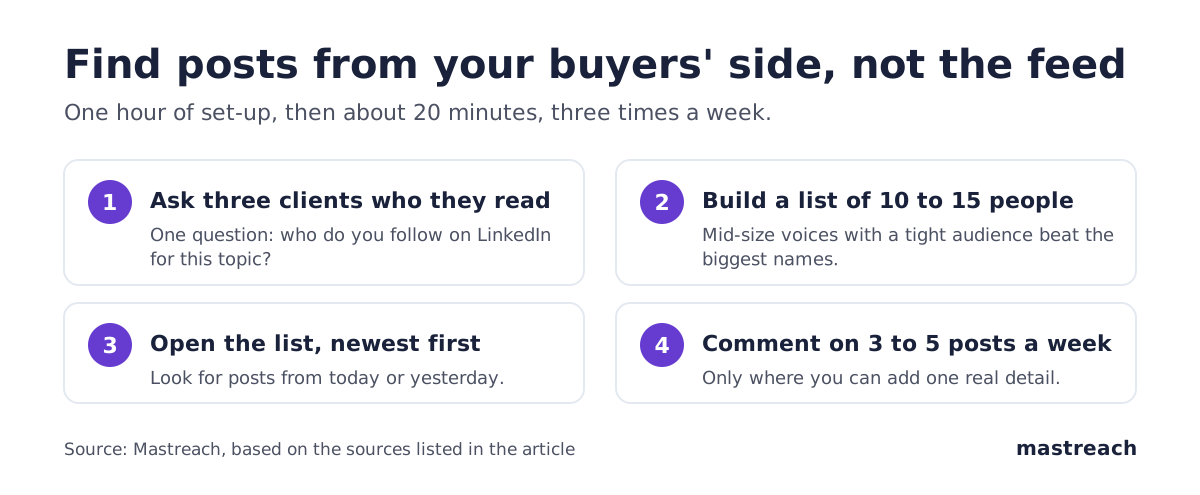
Ask them. You do not need a tool for the first step.
- Ask three clients. "Who do you follow on LinkedIn for [your topic]?" Most people name three or four people straight away.
- Look at a good client's activity. On a client's profile, open their recent activity and note whose posts they comment on or like.
- Read the comment sections of your own clients' posts. The senior people who comment there often share your buyers' audience.
Put the names in a list of 10 to 15 people. Chime suggests this size and adds a useful warning: do not choose only the biggest accounts. A very large account may reach only a few of your buyers, while a smaller one with a tight subject may reach many more. That is Chime's reading, not LinkedIn's, but it is common sense for anyone selling a specialist service.
A Dubai property adviser, for example, might list local developers' leaders, two regional investor newsletters and a handful of lawyers who advise buyers. Not a global celebrity in sight.
How recent should a post be?
Recent. Your comment borrows the post's audience, and a post nobody is opening any more has none to lend.
Two vendors give figures here. Chime advises commenting within about the first two hours of a post. Taplio, another LinkedIn tool maker, cites a study by LinkHub of 657,722 comments. It reports that a comment in the first half hour earns roughly four times the impressions of the same comment a day later.
Treat both as vendor claims, not LinkedIn facts. Our reading is simple: the same day is much better than three days later. You do not have to sit and refresh. Check your list in the morning and again after lunch.
If you comment from a different time zone to the author, such as a Sydney consultant reading a US post, aim for the next sensible window rather than staying up.
What makes a post worth a comment, and what is a trap?
A post is worth a comment when you can say something that only someone with your experience could say. Taplio lists four kinds of posts worth the effort:
- Posts in your own subject.
- Posts by people who could be your customers.
- Posts by creators whose audience you want to reach.
- Posts by friendly competitors whose offer sits next to yours.
Our reading is that the second and third matter most for a consultant, because those readers can hire you.
The traps are just as clear. A pure inspiration post leaves you nothing to add except "so true". A post for another industry sends the wrong signal about what you do. Taplio warns that commenting outside your field teaches LinkedIn the wrong thing about you, citing an analysis by Richard van der Blom. We have not verified that analysis, so take it as a caution, not a rule.
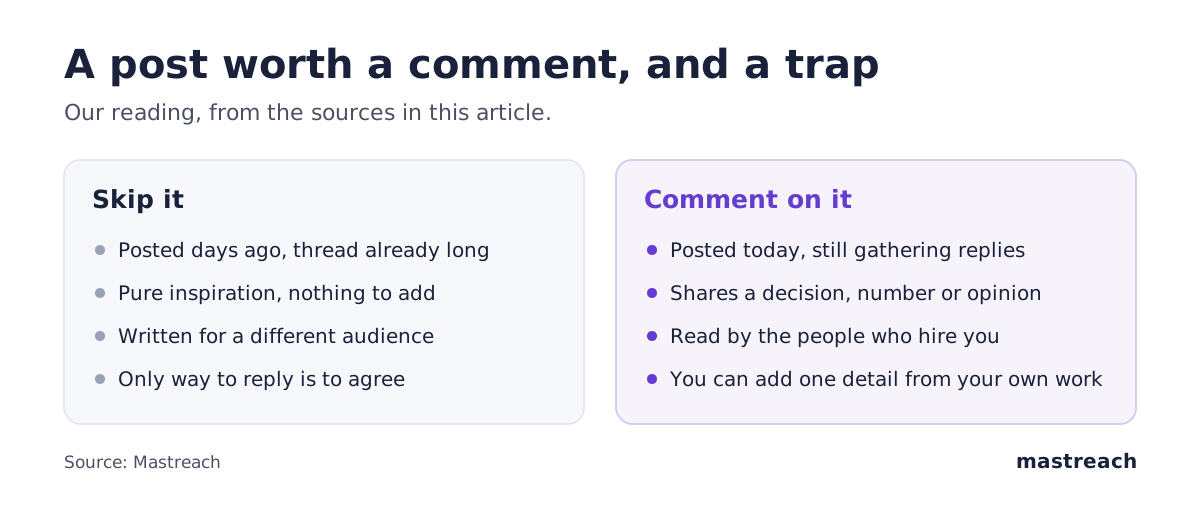
A quick test: can you add one sentence from your own work? A number you saw, a client situation (without names), a polite disagreement, or a question. If not, move on.
How many posts a week is enough?
Fewer than most advice says. Consultant Melanie Goodman looked at 140 consultants who get steady enquiries and reports that 121 of them commented on three to five posts a week, aimed at specific people. This is her own informal study, not a peer-reviewed one, so we use it only as a sign that quality beats volume.
For more on volume, see our article on how many LinkedIn comments a day is too many. The short version: a number you can keep up for months beats a burst you drop after two weeks.
A German engineering consultant with 20 minutes, three mornings a week, can comfortably do three to five comments in a week. That is a real routine.
How do you check that your post choices paid off?
LinkedIn shows the impressions for each comment, but one comment at a time. It does not total them. So most people never learn which kinds of posts brought reach.
Our own data shows why this is worth doing. Across 914 comments drafted in Mastreach and then posted, August to September 2026, LinkedIn reported 177,931 impressions, about 195 per comment. Some accounts did much better than others: a leadership trainer and speaker had 160 comments and 21,353 impressions in 14 days. A real estate investment firm had 55 comments and 15,519 impressions in 13 days.
Two cautions. Impressions are not unique people, because repeat views and your own views count. And we have no before-and-after comparison of post impressions for these accounts. See what 914 comments earned for the full picture.
The practical habit: once a week, write down each comment, the author, and the impressions LinkedIn shows. After a month, look for the authors and kinds of post that repeat at the top. Do more of those. Our article on comments before connecting shows what to do with the warm names you find.

Where Mastreach fits
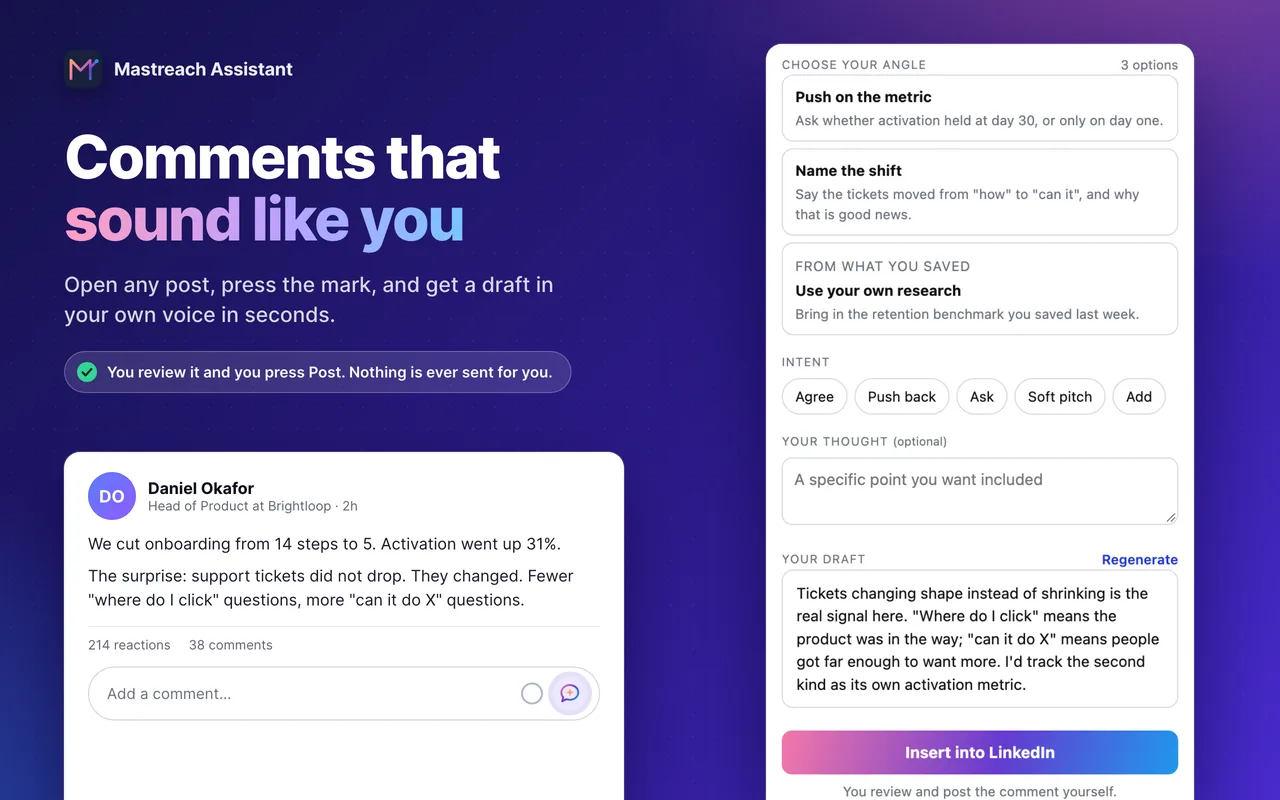
The slow part of this method is finding fresh posts your buyers read, then writing a comment worth reading. Mastreach helps with both, and you stay in charge.
- It shows posts in your subject that your buyers are reading.
- On any post, you pick an angle (push back, ask, add what is missing) and get a draft in your own voice.
- It records the impressions LinkedIn shows under each comment and adds them up by week, post and author.
You read, edit and post every comment yourself. Mastreach never posts, comments or messages for you.
Plans start at $29 a month at the founding price, and the 5-day free trial needs a card but charges nothing during the trial.
FAQ
How do I find LinkedIn posts to comment on without scrolling?
Make a list of 10 to 15 people your buyers follow, and check their latest posts a few times a week. Ask your clients who they read to start the list. Then you are working from your buyers' side, not from your feed.
Should I comment on posts from big influencers?
Only if your buyers follow them. A large account may reach few people who could hire you. A smaller, specialist account often gives a denser group of your buyers per comment. This is a common vendor view, not a LinkedIn rule.
How soon after a post should I comment?
As soon as you have something useful to add, ideally the same day. Vendors report much better results in the first half hour to two hours, but those figures are not from LinkedIn. Do not rush a weak comment just to be first.
How many comments a week do I need?
Three to five good ones is a sensible start for a consultant, based on one informal study of 140 consultants. Keep a number you can sustain, and check your impressions after a month.
Sources
See what your own comments are reaching.
Mastreach finds the LinkedIn posts your buyers are reading, drafts a comment in your voice, and counts the impressions LinkedIn never adds up for you. You post every comment yourself.
- 914 comments drafted with Mastreach and posted by their owners
- 177,931 LinkedIn impressions on those comments, August to September 2026