Get Clients on LinkedIn With a Small Following
A small LinkedIn following does not stop you winning clients. What two 2026 datasets show, and a four-week plan for under 1,000 connections.

Part of our LinkedIn comments guide: where to comment, what to write, and how to measure what it earns.
Can you win clients on LinkedIn with a small following? Yes. Follower count buys reach, but not response, and clients come from being known by a few right people, not by many wrong ones.
This article looks at what two 2026 datasets say, then gives a plan for a consultant, coach or founder with under 1,000 connections. It needs about 20 minutes, three times a week.
Does a small LinkedIn following stop you getting clients?
No. It makes each post reach fewer people, which is a real limit. But it does not stop the right buyer from reading your work, and it does not make that buyer less likely to answer.
Think of a UK tax consultant with 600 connections, an Indian software founder with 900, and a Dubai property adviser with 400. None of them needs 20,000 followers. Each needs perhaps 30 to 50 buyers to know their name and what they are good at.
That is a different job from building an audience. It is closer to being the person a small circle trusts.
What do 2026 datasets say about small accounts and reach?
Two vendor studies cover this. Neither is from LinkedIn, so treat the figures as indications, not facts about the platform.
AuthoredUp, a LinkedIn writing tool, studied 664,688 posts from 15,507 personal profiles, from August 2025 to July 2026. Posts with under 100 impressions were left out. Reach rises with network size:
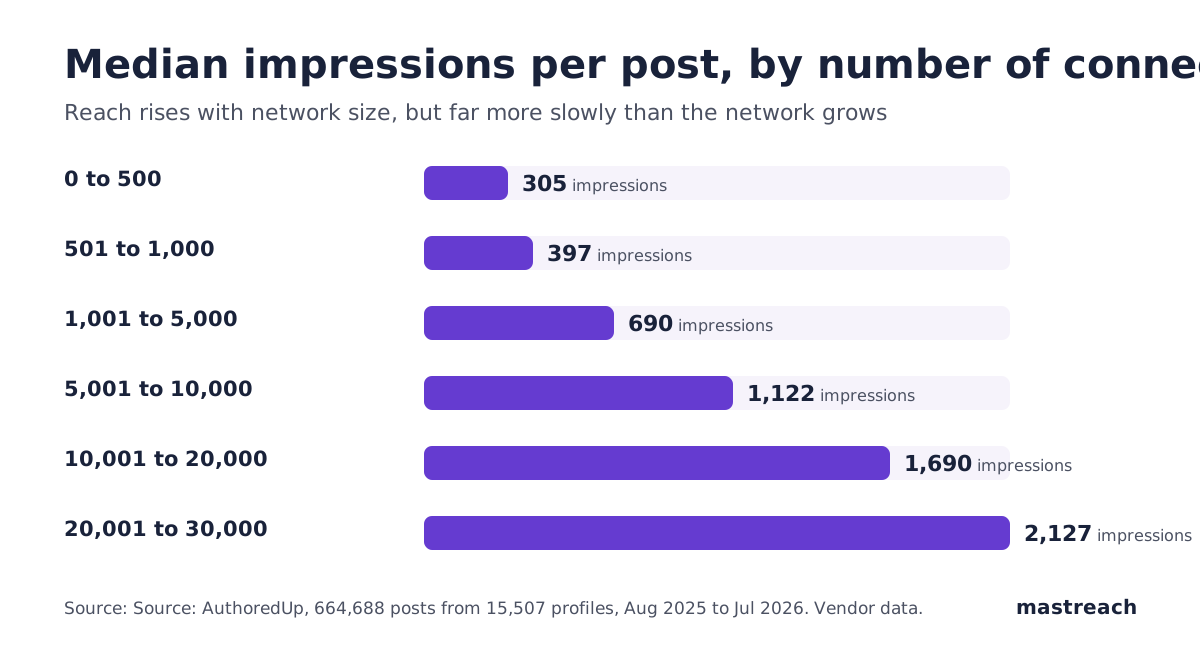
Read it with care. Going from under 500 connections to 20,001 to 30,000 is roughly sixty times the network. It returns about seven times the median reach.
Creative Content Crafts, a content agency, tracked 64,092 posts by 4,677 B2B authors over 30 days. It counted a "breakout" as a post earning at least five times its author's usual engagement. In its data, 5.2% of posts from accounts with 1,000 to 5,000 followers broke out, against 3.3% for accounts above 100,000.
Its summary is blunt: "Small accounts break out more often than large ones." The same study is honest about the other side. Large accounts produced most of the truly viral posts, and the median post from a 1,000 to 5,000 follower founder earned 7 engagements. So a small account will not often get big numbers. But a good post can still jump.
Why does engagement fall as the audience grows?
AuthoredUp found the median engagement rate peaked at 2.56% for accounts with 501 to 1,000 connections. It fell to 1.96% for accounts with 20,001 to 30,000. Creative Content Crafts saw the same shape in its own measure: the share of followers who act on a post falls sharply as accounts grow.
Our reading: a large audience is partly inventory, not attention. A small one is more often people who chose to be there. That is a good place to start a client conversation.
Where do a small account's first buyers actually come from?
Rarely from your own posts, at first. Few people see them. They come from the places where your buyers already are.
AuthoredUp makes the point that reach produces connections, not the other way round: people connect after your work appears in their feed. For a small account, the quickest way to appear in the right feeds is to be visible under other people's posts.
Our article on which LinkedIn posts to comment on explains how to build a list of 10 to 15 people your buyers read. That list matters more than your follower count.

How can comments put you in front of buyers without followers?
A comment sits under a post that already has readers. You borrow its audience for as long as the thread is alive, and the author sees your name.
Here is our own data. Between August and September 2026, comments drafted in Mastreach and then posted by users earned 177,931 impressions from 914 comments, about 195 per comment. These are impressions as LinkedIn reports them. They are not unique people, repeat views count, and we have no comparison with what the same accounts earned from posts.
The mix is wide. A leadership trainer and speaker posted 160 comments and saw 21,353 impressions in 14 days. A real estate investment firm posted 55 comments and saw 15,519 impressions in 13 days. The founder behind Mastreach posted 284 comments from his own account and saw 74,888 impressions over two months, while his followers went from 1,391 to 1,585. Follower data exists only for that account, and we cannot say comments alone caused the rise.
The point is not the totals. It is that a modest account can be seen by thousands of people without a big following, if the comments are useful.
For what a good comment looks like, the lesson in LinkedIn pinned comments applies: specific points beat quick praise.
What should you track instead of follower count?
Follower count tells you little. Better signs of progress:
- Conversations started. Replies, messages and calls that came from your visibility.
- Profile views from the right people. Are the viewers buyers, or other consultants?
- Comment impressions. LinkedIn shows these one comment at a time and does not add them up, so write them down weekly.
- Replies from people you wanted to reach. One reply from a target buyer is worth more than ten likes.
AuthoredUp's engagement-rate view helps too: a rate near 2.5% on a small account is about the median for its size in that dataset. Compare yourself with accounts your size, not with a celebrity.
A four-week plan for an account under 1,000 connections
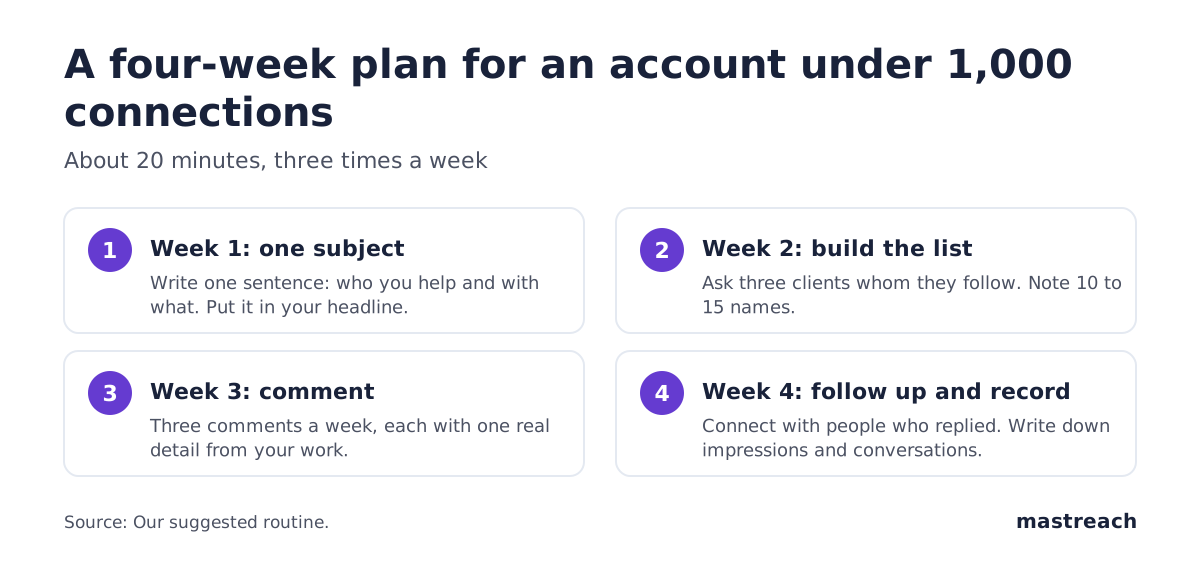
Week 1: choose one subject and one reader. Write one sentence: "I help [who] with [what]." Update your headline to say it. Our piece on why buyers go unseen explains why the quiet readers matter.
Week 2: build the list. Ask three clients whom they follow. Note 10 to 15 names.
Week 3: comment three times a week. Add one real detail from your work to each. No praise-only comments, no pitching.
Week 4: follow up and record. Connect with people who replied. Record impressions and conversations. Keep what worked.

Where Mastreach fits
Following the plan by hand is possible but slow. Mastreach is a LinkedIn positioning assistant for people who sell expertise, and it helps with the small-account problem of being seen by the right readers:
- It shows posts in your subject that your buyers are reading.
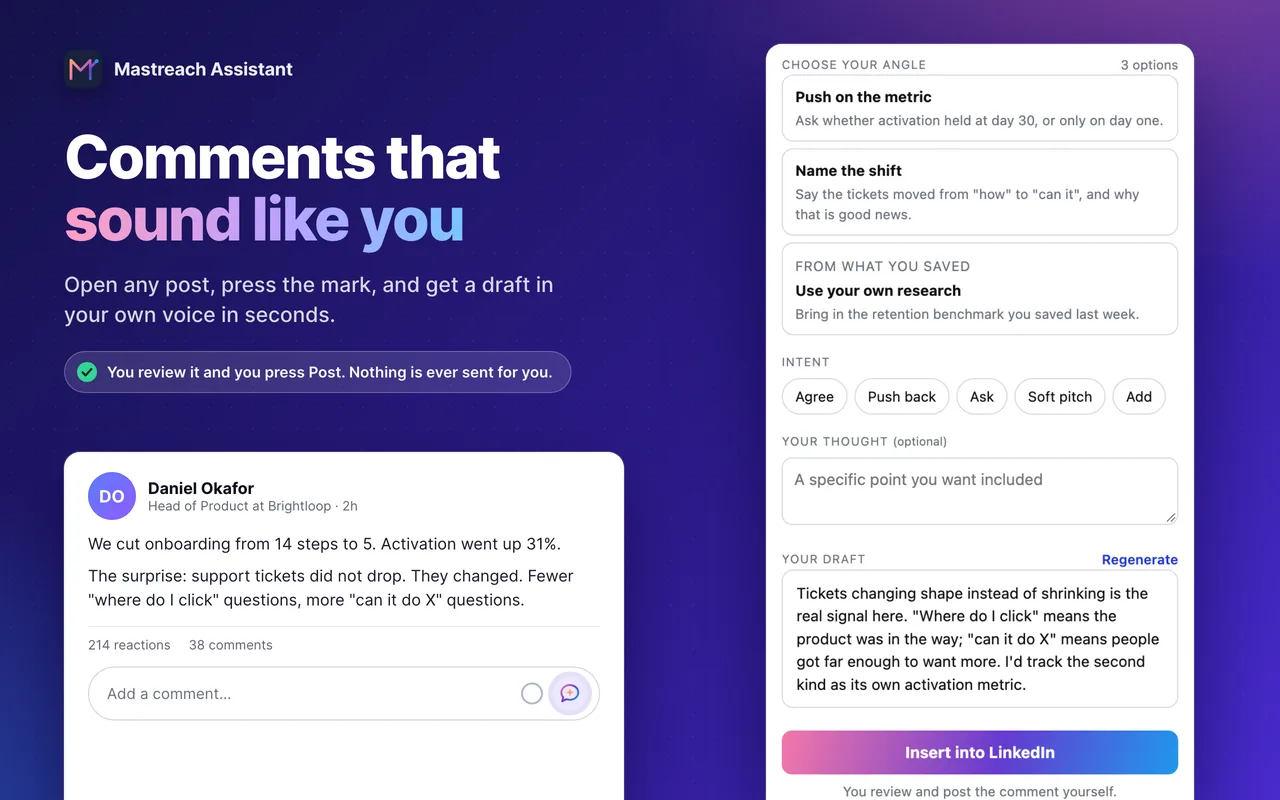
- It drafts a comment in your own voice, from an angle you pick.
- It adds up the impressions each comment earns, by week.
You read, edit and post every comment yourself. Mastreach never posts, comments or messages for you.
You can try it free for 5 days. A card is needed, but nothing is charged during the trial.
FAQ
How many followers do I need to get clients on LinkedIn?
There is no set number. A 2026 study found the highest engagement rate at 501 to 1,000 connections. Clients come from the right few people knowing your name, so a list of 30 to 50 target buyers matters more than a count.
Does posting more often help a small account?
It can. AuthoredUp found engagement peaked at four to five posts a week for most profiles, then fell at eight or more. A clear subject and quality matter more than volume, so start with two or three posts a week you can keep up.
Are these studies from LinkedIn?
No. Both are vendor datasets, and LinkedIn has not confirmed them. Use them as signs, not rules.
Can I get clients from comments alone?
Comments can start the conversation, not close the sale. They make you known to buyers. The client conversation still happens by reply, message or call.
Sources
See what your own comments are reaching.
Mastreach finds the LinkedIn posts your buyers are reading, drafts a comment in your voice, and counts the impressions LinkedIn never adds up for you. You post every comment yourself.
- 914 comments drafted with Mastreach and posted by their owners
- 177,931 LinkedIn impressions on those comments, August to September 2026