How buyers find consultants with AI, and what they see
Buyers now ask AI tools to shortlist providers. Here is what they find when they look you up, and a simple fix you can make this week.

Buyers now ask AI tools to build a shortlist of consultants, and you usually cannot see it happen. So the first impression of your business may form before anyone visits your website or sends you a message.
That sounds worrying, but the fix is small. Make what is public about you clear, specific and consistent. This article explains what LinkedIn said, what a buyer or an AI actually finds when they look you up, and what to change this week.
What did LinkedIn say about buyers using AI to shortlist providers?
On 7 October 2026, LinkedIn published a checklist for B2B marketers. Social Media Today reports that LinkedIn wrote: "Buyers now ask AI tools to shortlist providers and weigh options."
LinkedIn also said buyers research and form opinions about vendors long before they talk to sales. Because of AI tools, it said, that process is now "faster and harder to see".
The advice was written for large marketing teams that run ads. We are not suggesting you buy ads. But the point behind it applies to a one-person practice too: people decide who is worth a call before they contact you.
Why can you not see most of what buyers research about you?
Because most of it leaves no trace. A buyer who asks an AI tool "who can help a 40-person firm with export compliance?" does not click anything you own. They read the answer, note two or three names, and move on.
Your website analytics will not show it. Your inbox will not show it. You only see the result, if you are lucky: a message that says "I was told to talk to you."
There is some outside research on this, though it is secondhand. The Drum reported figures from Forrester that 68% of buyers already have a preferred vendor in mind before a formal process begins. The same article calls the buying journey "a process of confirmation, not selection". We have not seen the Forrester report itself, and it is about B2B buying in general, not about small consultancies, so treat the number as a signal rather than a rule.

What do buyers and AI tools find when they look up a consultant?
They find whatever is public and easy to read. For most solo experts that is four things:
- Your LinkedIn profile. The headline, the About section and your featured items.
- Your recent posts and comments. What you say in public, and how often you say it on one subject.
- Your website. Often a few pages, rarely updated.
- Mentions by other people. Reviews, podcasts, articles, a quote in someone else's post.
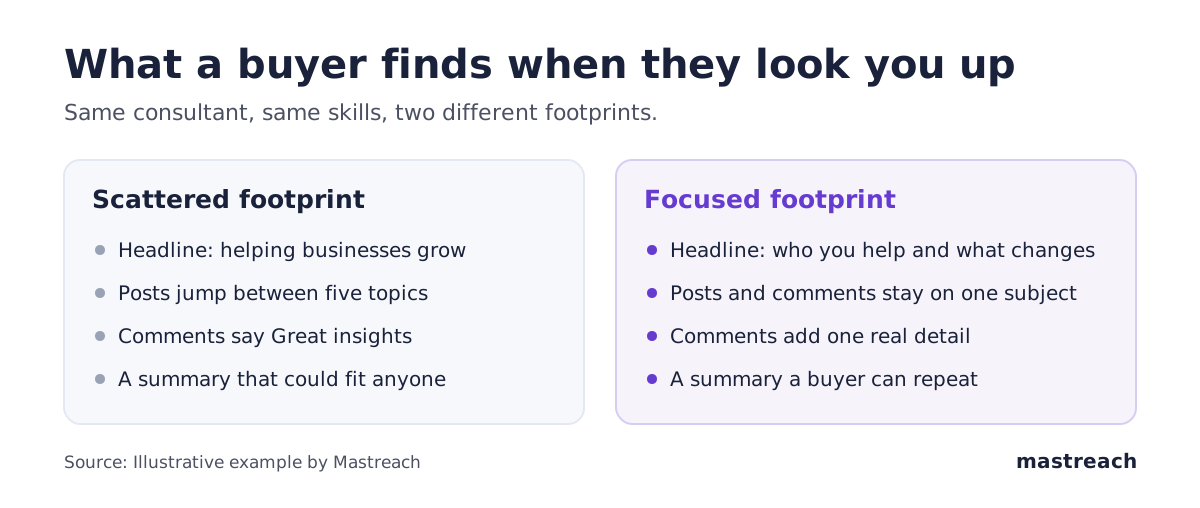
An AI tool does not read your mind. It reads what exists and summarises it. If your profile says "helping businesses grow", your posts are about hiring, and your comments are about travel, the summary will be vague. A vague summary does not get you on a shortlist.
Compare two cases. A UK consultant who writes "I help family-owned manufacturers prepare for a sale" on her profile, and comments on posts about succession and valuation, gives a clear picture. A US agency owner who says "full-service digital solutions" gives none.
Does LinkedIn content influence the answers AI gives?
Probably yes, to some degree, but the evidence is thin and you should not oversell it.
The Drum article says LinkedIn is currently the second most cited source across major AI search tools, including ChatGPT and Google AI Mode. That is a trade writer reporting a claim, and other studies put the numbers differently. We looked at that in detail in are LinkedIn posts cited by ChatGPT. Two studies there gave very different answers, from under 1% to 11%, depending on what was asked.
So here is the honest position. Nobody outside the AI companies can tell you exactly how a given answer is built. Our reading: a clear, steady public record on one subject cannot hurt, helps human buyers for certain, and may help AI tools too. That is a good bet for a small cost.
What should a small firm change on its profile this week?
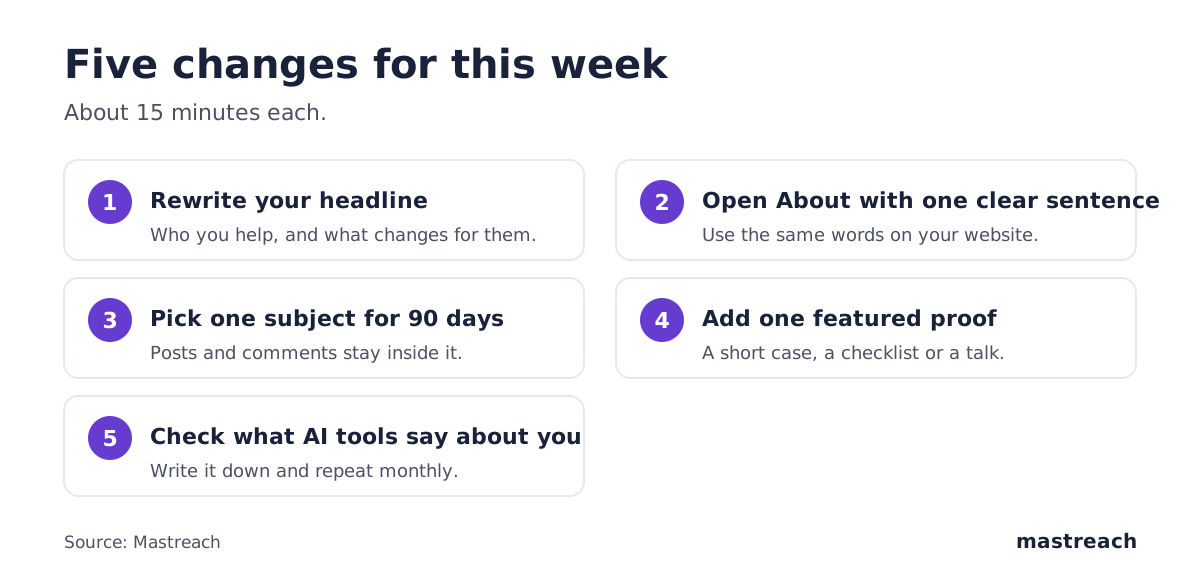
Do these five things. Each takes about 15 minutes.
- Rewrite your headline as "who you help" plus "what changes for them". Example: "I help Gulf-based family firms hire their first finance director."
- Open your About section with one sentence a stranger can repeat. Put the same words near the top of your website.
- Pick one subject for the next 90 days of posts and comments. We cover how in why your LinkedIn reach is low.
- Add one featured item that proves the claim: a short case, a checklist, a talk.
- Check your name and firm in two or three AI tools (see the last section). Write down what they say.
How do specific comments help you get named?
A comment is public, dated and tied to your profile. It shows what you know, in your own words, in front of the exact people who read that post.
Our data gives a rough sense of the reach involved. Across 914 comments drafted in Mastreach and then posted, LinkedIn reported 177,931 impressions, about 195 per comment. The details are in what 914 comments earned. Three caveats: impressions are not unique people, because repeat views and your own views count; we have no before-and-after impression comparison for these accounts; and we cannot show that any comment led to an AI mention.
What we can say is simpler. A specific comment on a post your buyers read puts your name and your subject in front of them. A buyer who has seen your name three times under posts about export compliance will remember it when they ask a colleague, or an AI tool, for a shortlist.
Generic comments do the opposite. "Great insights!" teaches nobody anything and leaves no footprint. Add one real detail from your work, and mention only what you can stand behind. You write and post every comment yourself, and that is as it should be. A tool such as Mastreach can help you find the right posts and draft a first version in your voice, but you read it, edit it and post it.
How do you check what an AI says about you?
Run this check once a month. It takes ten minutes.
- Ask two or three AI tools: "Who is [your name], and what do they do?" and "Who are good [your type of consultant] for [your type of client] in [your country]?"
- Write down whether you are named, and what is said.
- Check whether the description matches what you want to be known for.
- If it is wrong or vague, fix the source: your profile, your website, a recent post.
Results change between tools and between days, so do not treat one answer as a ranking. Look for patterns. If three tools describe you in the same plain sentence, your positioning is working. If they describe you differently each time, that is the work to do.
Where Mastreach fits
If buyers and AI tools judge you by what they can find, the cheapest thing to improve is the trail of comments you leave on LinkedIn. Specific comments under the right posts tell both a person and a machine what you know. Mastreach is built for that.
- Right posts. It shows you posts in your subject that your buyers are reading.
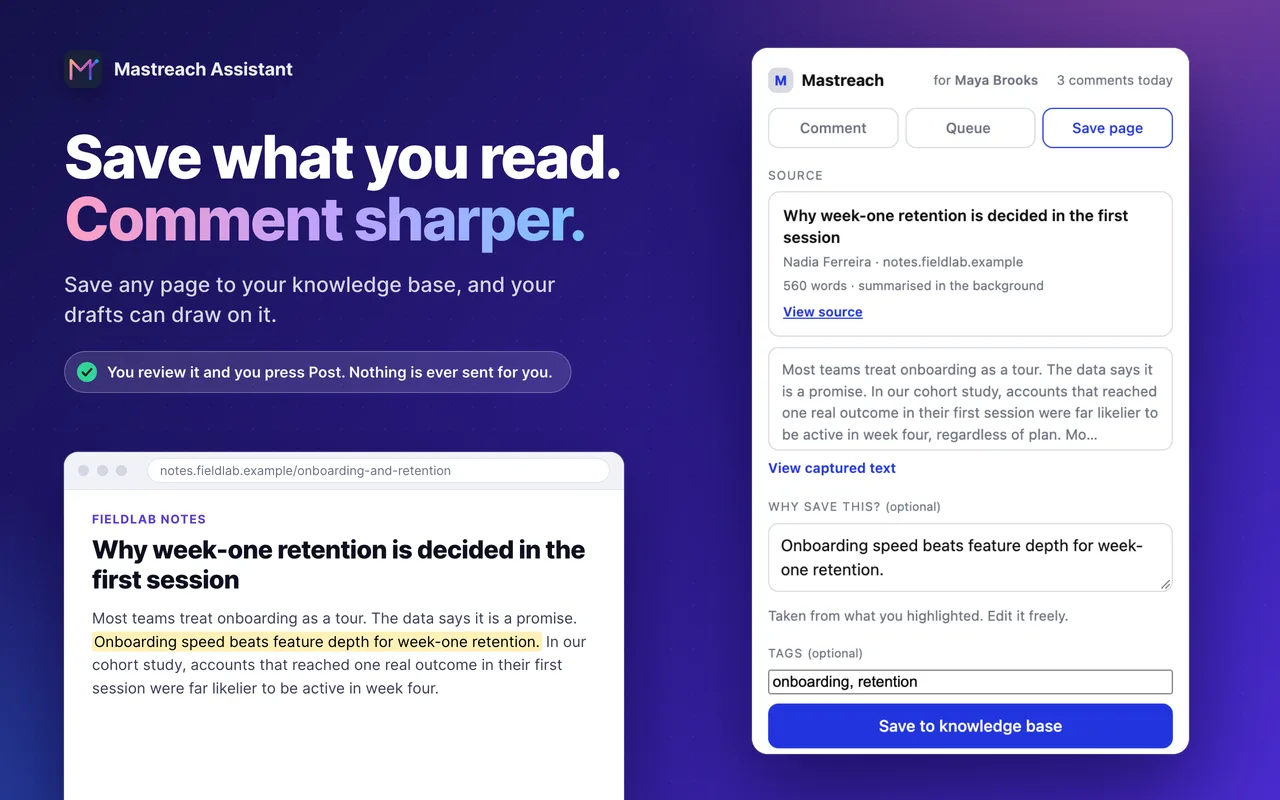
- Real substance. Save the pages you read and the points you care about. Your comment drafts can use them, so each comment says something only you would say.
- Your voice, your click. You pick the angle, edit the draft and post it yourself.
It also totals the impressions your comments earn, which LinkedIn never adds up for you. You can try it free for 5 days.
FAQ
Do buyers really use AI to find consultants?
LinkedIn says so in its October 2026 guidance for B2B marketers: buyers ask AI tools to shortlist providers. We do not have a count of how many do it, and it varies by industry. Treat it as a growing habit, not a universal one.
Can I see when an AI tool mentions me?
Not directly. You can search for yourself in a few tools from time to time, and you can ask new clients how they found you. A simple question at the first call, "What made you reach out?", often tells you more than analytics.
Should I post more to be mentioned by AI?
Not necessarily. A steady, clear record on one subject matters more than volume. Posting daily on five topics is likely to blur your picture, not sharpen it.
Is it safe to use AI to help write my comments?
Yes, if you stay in control. Read every draft, change anything that is not true to you, and post it yourself. Avoid tools that comment for you, which LinkedIn is clamping down on.
Sources
- LinkedIn shares checklist for B2B marketing campaigns (Social Media Today, 7 October 2026)
- Why your buyers have already decided before you know they exist (The Drum, 28 May 2026)
- Mastreach data: comments drafted in Mastreach and posted, August to September 2026, impressions as LinkedIn reports them.
See what your own comments are reaching.
Mastreach finds the LinkedIn posts your buyers are reading, drafts a comment in your voice, and counts the impressions LinkedIn never adds up for you. You post every comment yourself.
- 914 comments drafted with Mastreach and posted by their owners
- 177,931 LinkedIn impressions on those comments, August to September 2026