Why is my LinkedIn reach low? Too many topics
Hiring on Monday, AI on Wednesday, a flight story on Friday. Why one clear subject beats five on LinkedIn's 2026 feed, and how to choose yours.

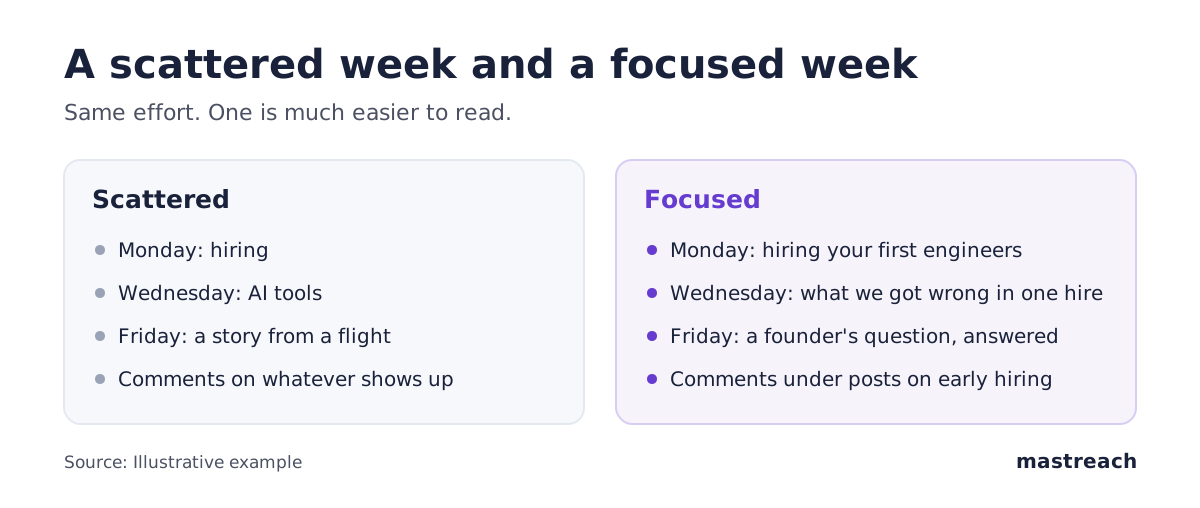
Most people with low LinkedIn reach are not short of effort. They post regularly, they comment, they try the advice. What they are short of is aim. Hiring on Monday, AI on Wednesday, something from a flight on Friday. Each post is fine on its own. Together they describe nobody in particular.
Why is my LinkedIn reach low?
There are many possible reasons, and LinkedIn says "a wide range of factors" affects distribution (LinkedIn Help). But in our experience one reason is both common and fixable: your activity does not make it clear what you are about, so it is harder to tell who should see you.
The 2026 feed ranks posts by understanding their subject and matching them to members whose interests fit. LinkedIn's engineers say the system "better understands what a post is actually about and how it relates to a member's evolving interests" (LinkedIn Engineering Blog, 12 March 2026). Our reading: when your activity is spread across five unrelated subjects, each post has a weaker history to be matched on.
How does LinkedIn decide what you are about?
LinkedIn's announcement says the feed looks at what posts are about and "how members' interests change over time" (LinkedIn Pressroom, 12 March 2026). Its engineers list the actions the model learns from as "long dwells, likes, comments, shares" (LinkedIn Engineering Blog). So it is not only your posts. Our reading is that a clear subject in your comments strengthens a clear subject in your posts.
Think of it as being readable. If someone looked only at your last ten pieces of activity, posts and comments together, could they say in one sentence what you know about and who you help? If they could not, neither can a ranking system.
Does posting less often hurt your reach?
This is our view rather than LinkedIn's: not if what you post is focused. Frequency gets most of the attention in LinkedIn advice, but more posts on scattered topics just produce more scattered signals. A smaller amount of activity that is clearly about one subject is easier to match to the right readers.
Comments help here because they are cheap. Writing a strong post takes an hour. Writing a strong comment under someone else's post in your subject takes a few minutes, and each one adds to the picture of what you are about.
How to choose your one subject
You do not need a personal brand workshop. You need honest answers to four questions.
- Who buys from you? Not "business owners". Something like "founders of 10 to 50 person software companies" or "HR heads at mid-sized manufacturers in Europe".
- What problem do you solve for them? The thing they would pay to make go away.
- What do you know about it that most people do not? From your own projects, clients and mistakes.
- What are those buyers already reading on LinkedIn? Whose posts, which conversations. These are your rooms.
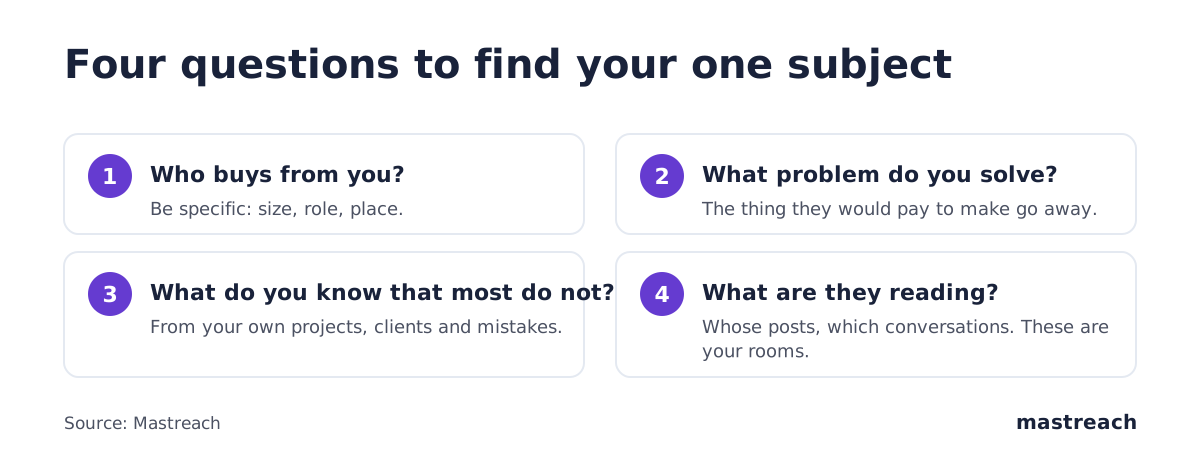
Your subject is where the second and third answers meet. "Hiring your first engineers without a technical co-founder." "Making AI useful for a small team." "Getting real estate investors past their first property." It is narrow on purpose.
What about everything else you want to post?
You can still post about other things. Focus is a positioning choice, not a rule that you may never mention your weekend. The aim is that most of your activity, especially your comments, reads as one subject. An occasional personal post among thirty focused ones does no harm. Thirty posts on thirty topics does.
What happened when accounts stayed on one subject
In August and September 2026 we counted comments written with Mastreach, which keeps each account's comments inside the subject it chose. Across 914 comments, LinkedIn reported 177,931 impressions. Our founder's account wrote 284 of them over two months, earned 74,888 impressions, and grew from 1,391 to 1,585 followers in the same period. We cannot separate the effect of focus from everything else that happened in those months, and we only tracked followers on that one account, so treat it as one example rather than proof. The full numbers are in what 914 comments showed us.

A one-week reset
- Day 1. Write your subject in one sentence and your buyer in one sentence. Put both in your headline in plain words.
- Day 2. Make a list of 15 people your buyers follow. These are your rooms.
- Days 3 to 7. Every day, leave three thoughtful comments under their posts, inside your subject. Add an example, a number or a view from your work.
- End of the week. Note the impressions on each comment. Here is where to find them. Keep the rooms that worked, swap the rest.
Where Mastreach fits
Choosing one subject is a decision. Staying on it every day is the hard part, because the feed keeps offering you everything else. Mastreach is set up around your subject:
- You name your subject and who you want to reach.
- It shows you posts on that subject that those people are reading, so your comments stay on topic without effort.
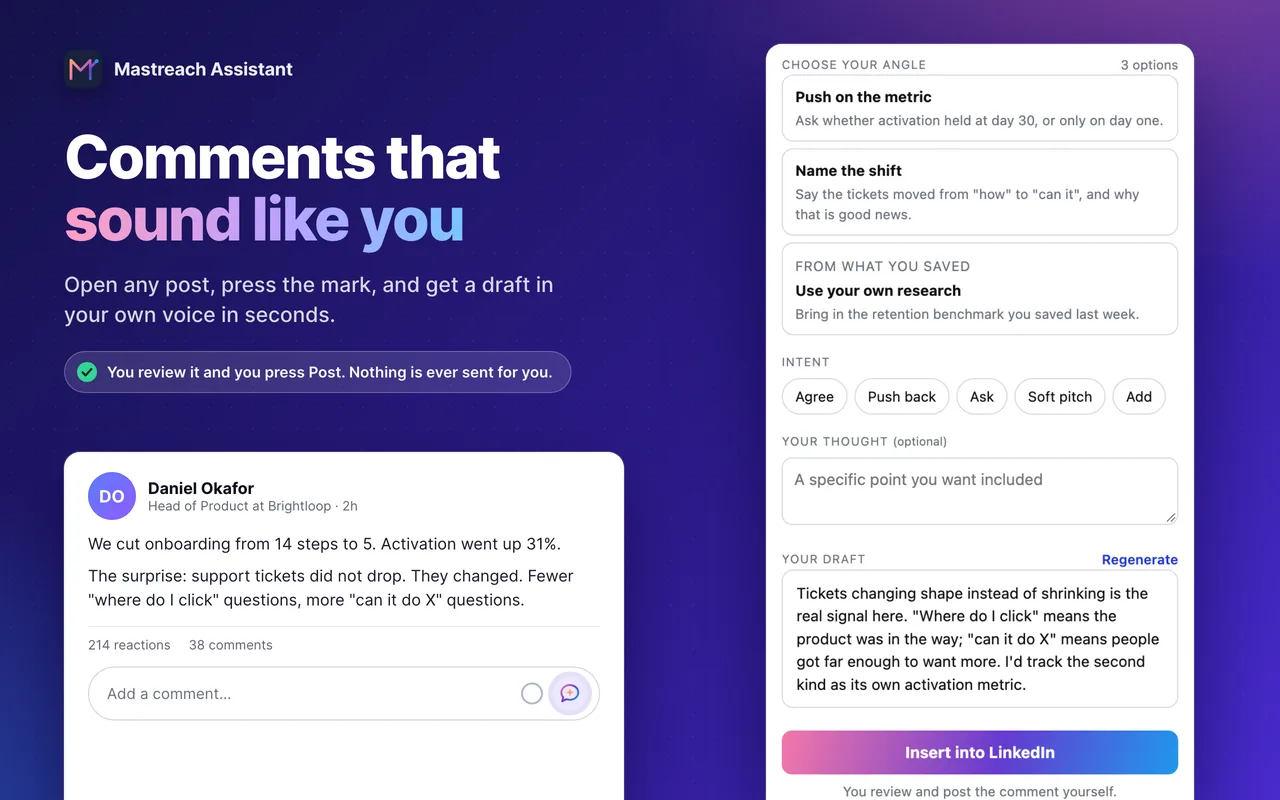
- It drafts a comment in your voice. You edit it and post it yourself.
It also adds up the impressions your comments earn, so you can see whether focus is paying off. You can try it free for 5 days.
FAQ
Why did my LinkedIn reach suddenly drop?
We cannot tell what caused a particular drop; many things affect reach. One change worth knowing: in March 2026 LinkedIn moved its feed to matching posts by subject. Accounts whose activity covers many unrelated topics may find their posts harder to match to interested readers.
Should I post about only one topic on LinkedIn?
Most of your posts and comments should be about one subject your buyers care about. Occasional posts on other things are fine. The goal is that your activity is readable as one clear area of expertise.
Do comments affect what LinkedIn thinks I am about?
LinkedIn's engineers list comments among the actions its feed model learns from. Our reading is that a run of comments in one subject reinforces that subject.
How long does it take for reach to improve after focusing?
It varies by account and subject. A practical approach is to keep one subject for at least a few weeks, count your comment and post impressions weekly, and judge the trend rather than single days.
Sources
See what your own comments are reaching.
Mastreach finds the LinkedIn posts your buyers are reading, drafts a comment in your voice, and counts the impressions LinkedIn never adds up for you. You post every comment yourself.
- 914 comments drafted with Mastreach and posted by their owners
- 177,931 LinkedIn impressions on those comments, August to September 2026