LinkedIn algorithm 2026: what changed, in plain English
In March 2026 LinkedIn rebuilt how its feed picks posts. Here is what changed, in LinkedIn's own words, and what it means for your reach.

In March 2026 LinkedIn moved its feed to ranking posts by what they are about, using large language models, rather than mainly by who is connected to whom. It announced this on 12 March 2026 in two pieces: a Pressroom announcement and a technical write-up on its Engineering Blog. A lot of what has been written about it since is guesswork. This article sticks to what LinkedIn actually said, and then explains what it means for a founder, coach or consultant who wants to be seen by the right people.
What did LinkedIn change in 2026?
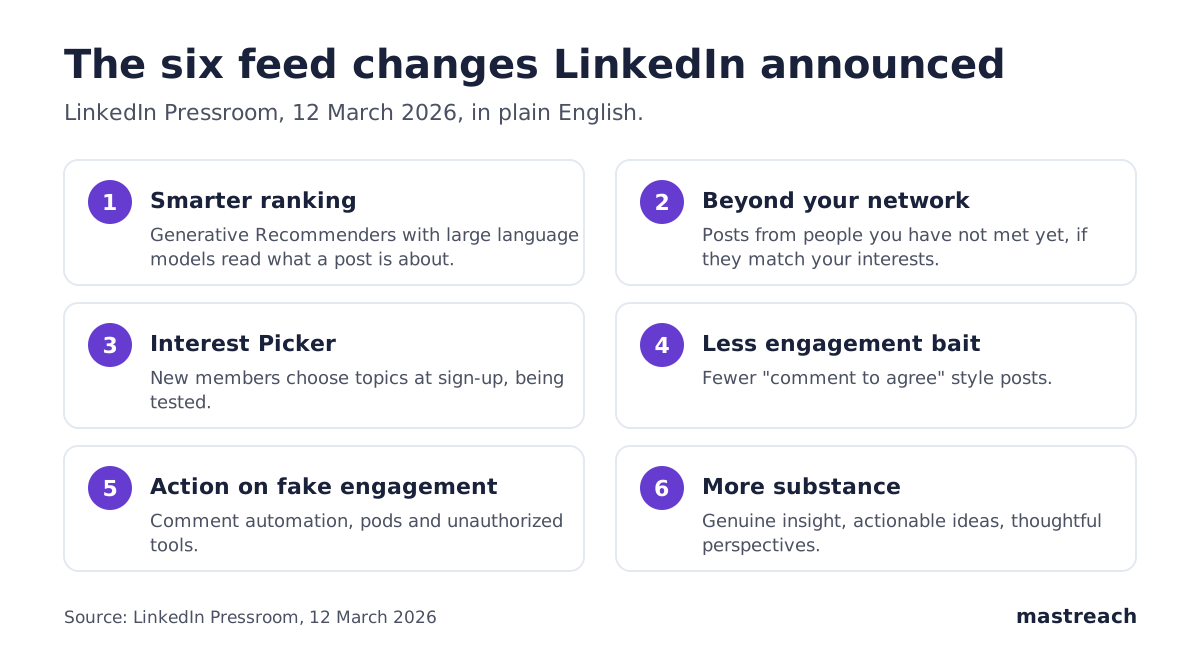
LinkedIn listed six changes in its announcement (LinkedIn Pressroom, 12 March 2026). In plain English:
- A smarter ranking system. The feed now uses what LinkedIn calls Generative Recommenders, "augmented with large language models", to understand what each post is about and how a member's professional interests change over time.
- Posts from outside your network. The feed aims to show what matters to you "whether they come from your network or professionals you haven't met yet".
- An Interest Picker for new members. LinkedIn is testing a step at sign-up where new members choose topics such as Leadership or Career Growth, so their feed is relevant from day one.
- Less engagement bait. LinkedIn says it will reduce repetitive, low-substance posts and prompts such as "comment to agree".
- Action against fake engagement. LinkedIn says it will act against "comment automation, engagement pods, and unauthorized third-party tools".
- More substance. The stated aim is more posts with genuine insight, actionable ideas and thoughtful perspectives, and fewer designed purely to game distribution.
How does the new LinkedIn feed decide who sees your post?
The Engineering Blog explains the machinery (Engineering the next generation of LinkedIn's Feed). Two ideas matter for ordinary users.
It reads what your post is about. Instead of relying mostly on who reacted to what, LinkedIn now turns posts into language-model representations of their meaning. The system "better understands what a post is actually about and how it relates to a member's evolving interests". A post about pricing a consulting offer can be matched to people interested in consulting and pricing, even if they have never interacted with you.
It looks at your history as a sequence. LinkedIn says the model "processes more than a thousand of your historical interactions", in order, to judge what they are likely to find useful next. In LinkedIn's words, "LLM embeddings generalize beyond observed behavior", which means the system can make a sensible guess about a topic someone has not engaged with before.
Followers matter less. Topic matters more.
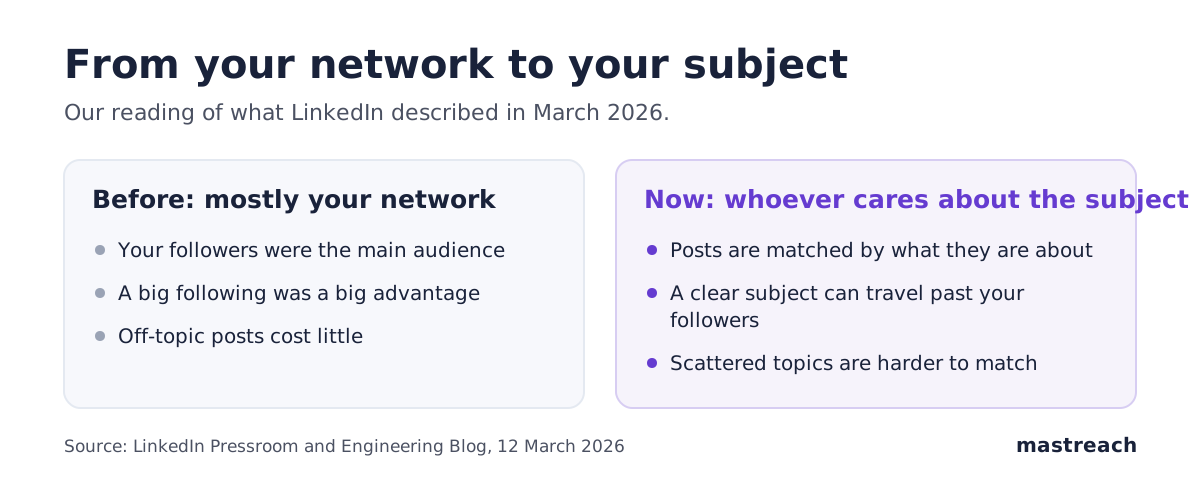
This section is our reading of what LinkedIn described, not LinkedIn's words. Under the old model, your audience was mostly your network. Your followers were a wall: everyone inside could hear you and nobody outside did. The 2026 feed turns that wall into a dotted line. A post, or a comment, that is clearly about a subject can travel to people who care about that subject, whether they follow you or not.
That cuts both ways:
- Your following stopped protecting you. A large following that does not care about what you write now is worth less than it was.
- Your following stopped limiting you. A small account with a clear subject can, in principle, reach interested readers it is not connected to.
LinkedIn is now also testing a Network feed made only of people you follow or are connected to, so the wall may come back in part. We cover what is known in the Network feed test in the US, UK, India and Australia.

What does the 2026 LinkedIn algorithm mean for your comments?
LinkedIn's announcement does not describe how comments are ranked, and its engineers did not write about that either, so be wary of anyone who claims to know the exact formula. Two things are clear from what LinkedIn did say:
- Comments are part of your history. LinkedIn's engineers list comments among the actions the model learns from ("long dwells, likes, comments, shares") (LinkedIn Engineering Blog). Our reading is that what you comment on is part of the picture LinkedIn builds of you. A run of comments on one subject reinforces it. Comments everywhere blur it. LinkedIn has also said its AI slop classifiers now cover posts shown beyond your network; see what AI slop detection means for comments.
- Automation is a named target. LinkedIn put comment automation and engagement pods in its own announcement. Tools that post comments for you, or groups that comment on each other's posts on a schedule, are the behaviour the company says it is working against. We cover this in LinkedIn engagement pods and comment automation.
LinkedIn's help page adds that "a wide range of factors" affects how far a comment travels (LinkedIn Help). In our own data, the post a comment sits under was by far the biggest one. See what 914 comments earned.
What should you do differently now?
- Decide who you are for. Write down the one subject you want to be known for and the people who buy from you. Everything else follows from this. We explain why in one subject beats five.
- Make every post and comment readable as that subject. If someone saw only your last ten pieces of activity, could they tell what you do?
- Comment in the rooms your buyers read. The new feed matches by topic, so a thoughtful comment under a popular post in your subject is a direct line to people interested in it.
- Drop the tricks. "Comment YES for the template", pods and auto-commenters are exactly what LinkedIn has said it is reducing.
- Measure what reached people. Post analytics are easy to find. Comment impressions are shown one at a time and added up nowhere. Here is how to see them.
Where Mastreach fits
The 2026 changes reward two habits: staying on one subject, and writing real comments rather than automated ones. Mastreach helps with both.
- It keeps you on your subject. You tell it what you are known for, and it shows you posts in that subject that your buyers are reading.
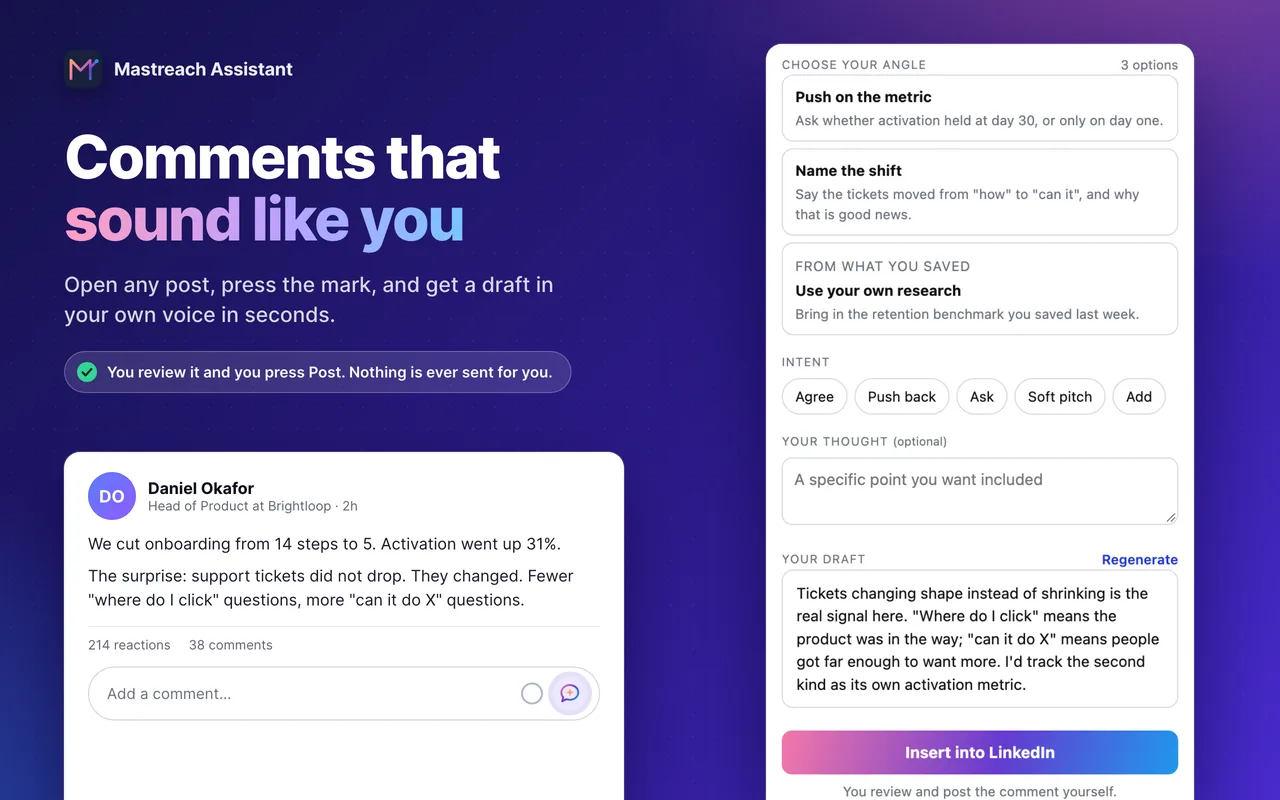
- It drafts real comments. Pick an angle from the post and get a draft in your own voice. You edit it and post it yourself. Nothing is automated on LinkedIn.
- It shows what is working. It adds up the impressions your comments earn, which LinkedIn does not total for you.
Across 914 comments drafted in Mastreach and posted by their owners in August and September 2026, LinkedIn reported 177,931 impressions. Impressions are not unique people. You can try it free for 5 days.
FAQ
Did the LinkedIn algorithm change in 2026?
Yes. On 12 March 2026 LinkedIn announced a feed ranked by Generative Recommenders augmented with large language models, more content from outside your network, an Interest Picker for new members, less engagement bait, and action against comment automation and engagement pods.
Does LinkedIn still show posts to people who do not follow you?
Yes, and more deliberately than before. LinkedIn says the feed now reflects what matters to each member whether a post comes from their network or from professionals they have not met yet.
Does follower count still matter on LinkedIn in 2026?
It matters less than it did. The new feed matches posts by what they are about, so a clear, consistent subject can reach interested people beyond your followers, while a large but unrelated following counts for less.
Is engagement bait penalised on LinkedIn?
LinkedIn says it will reduce repetitive, low-substance posts and engagement bait such as "comment to agree" prompts. It has not published penalties, but the direction is clear.
Sources
See what your own comments are reaching.
Mastreach finds the LinkedIn posts your buyers are reading, drafts a comment in your voice, and counts the impressions LinkedIn never adds up for you. You post every comment yourself.
- 914 comments drafted with Mastreach and posted by their owners
- 177,931 LinkedIn impressions on those comments, August to September 2026