Are LinkedIn engagement pods against the rules in 2026?
Yes. LinkedIn named engagement pods and comment automation as behaviour it acts against. What it said, and what works better instead.

Part of our LinkedIn comments guide: where to comment, what to write, and how to measure what it earns.
For years the shortcut to LinkedIn reach was to get people to comment on your posts quickly. Engagement pods organised it: a group agrees to like and comment on each other's posts as soon as they go live. Then came tools that write and post comments automatically, under your name, on dozens of posts a day. In 2026 LinkedIn put both on notice, in writing.
What did LinkedIn say about pods and automation?
In its March 2026 feed announcement, LinkedIn said it would "take action to stop behaviors that promote inauthentic engagement, including comment automation, engagement pods, and unauthorized third‑party tools" (LinkedIn Pressroom, 12 March 2026). In the same announcement it said it would reduce engagement bait, such as "comment to agree" prompts, and show more posts with genuine insight, actionable ideas and thoughtful perspectives.
It is rare for a platform to name specific tactics in a public announcement. When it does, it is a statement of direction worth taking seriously.
What is a LinkedIn engagement pod?
A pod is a group of people, usually organised in a private chat group, who agree to engage with each other's posts. When a member posts, they drop the link in the group and the others react and comment within minutes. The theory is that early activity convinces LinkedIn the post is worth showing to more people.
Pods vary in size and formality. They all share one thing: the engagement comes from the arrangement, not from the post.
Can LinkedIn tell when a pod is at work?
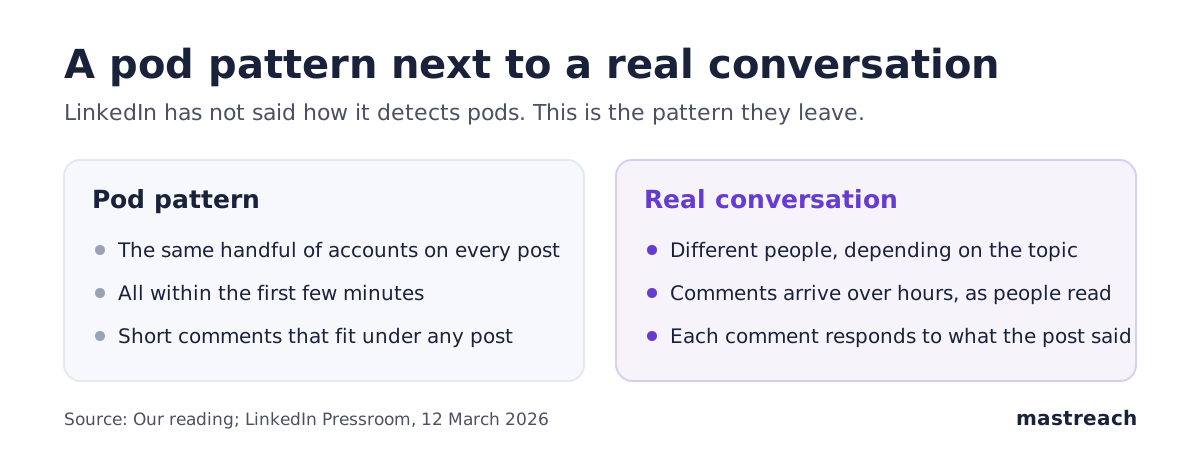
LinkedIn has not said how it detects pods. What we can say is that they leave a pattern: The same handful of accounts commenting on every post a member publishes, within the first few minutes, every time, with short comments that could sit under any post. One instance looks like friendship. A hundred instances look like a system.
LinkedIn's engineers also describe a ranking model that understands what a post is about and reads each member's interactions as a long sequence over time (LinkedIn Engineering Blog). They do not say this is used to catch pods, and we will not pretend to know. But it is reasonable to expect that a pattern repeated on every post is not hard for LinkedIn to see.
What about AI tools that comment for you?
Automated commenters are a different shortcut with the same weakness. They scan the feed and post generated comments under your name without you reading the post. The comments tend to be generic praise or a restatement of the post, at a volume and speed no person keeps up.
Three problems, in order of how much they should worry you:
- Your name is on every one. A thoughtless comment under a client's post, or a confident reply that gets a fact wrong, is your reputation, not the tool's.
- They are named in LinkedIn's announcement. Comment automation and unauthorized third-party tools are both on the list.
- They work against what LinkedIn says it wants. The announcement asks for posts with "genuine insight, actionable ideas, and thoughtful perspectives". A generic comment posted unread is the opposite, and it is unlikely to earn a reader's click.

Is it wrong to use AI to help write LinkedIn comments?
There is a real difference between a tool that posts for you and a tool that helps you write. Drafting is not the problem. Spell-checkers, grammar tools and assistants have helped people write for years. The problem is removing the person: nobody reads the post, nobody decides whether to comment, nobody checks what goes out.
A sensible line is this: you read the post, you decide, you post. If a draft helps you say what you actually think, faster, that is a writing aid. If comments appear under your name that you never saw, that is automation.
What works instead of pods and automation?
The things the new feed is built to reward, done consistently:
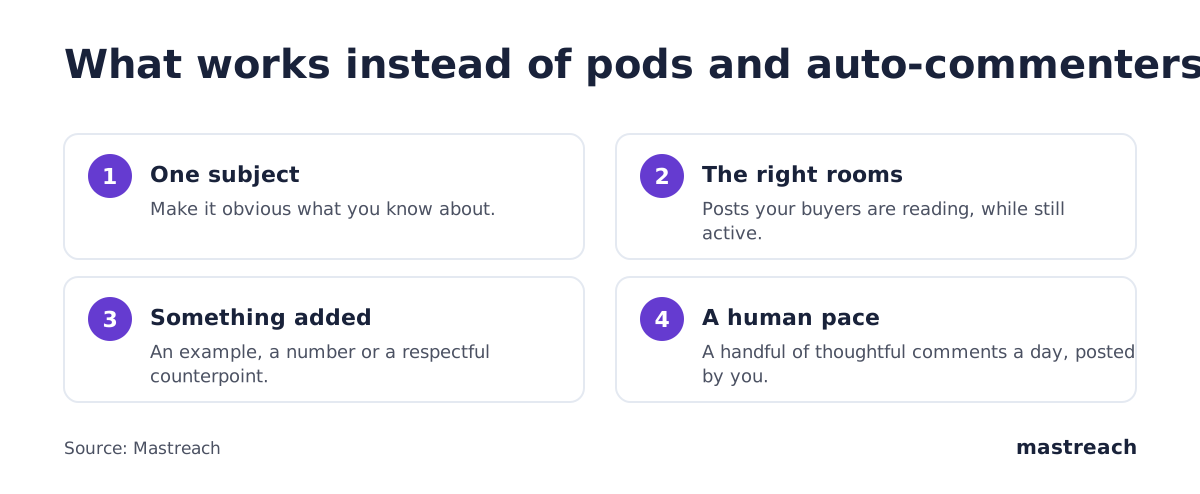
- One subject. Comments and posts that make it obvious what you know about. See why one subject beats five.
- The right rooms. Comment under posts your buyers are reading, in your subject, while they are still active. In our data the choice of post explained most of the difference in reach between accounts. See what 914 comments earned.
- Something added. An example from your work, a number, a respectful counterpoint. A comment worth reading is a comment worth showing.
- A human pace. A handful of thoughtful comments a day, posted by you.
- Measurement. Count what your comments reached so you know which rooms are worth your time. Here is how.
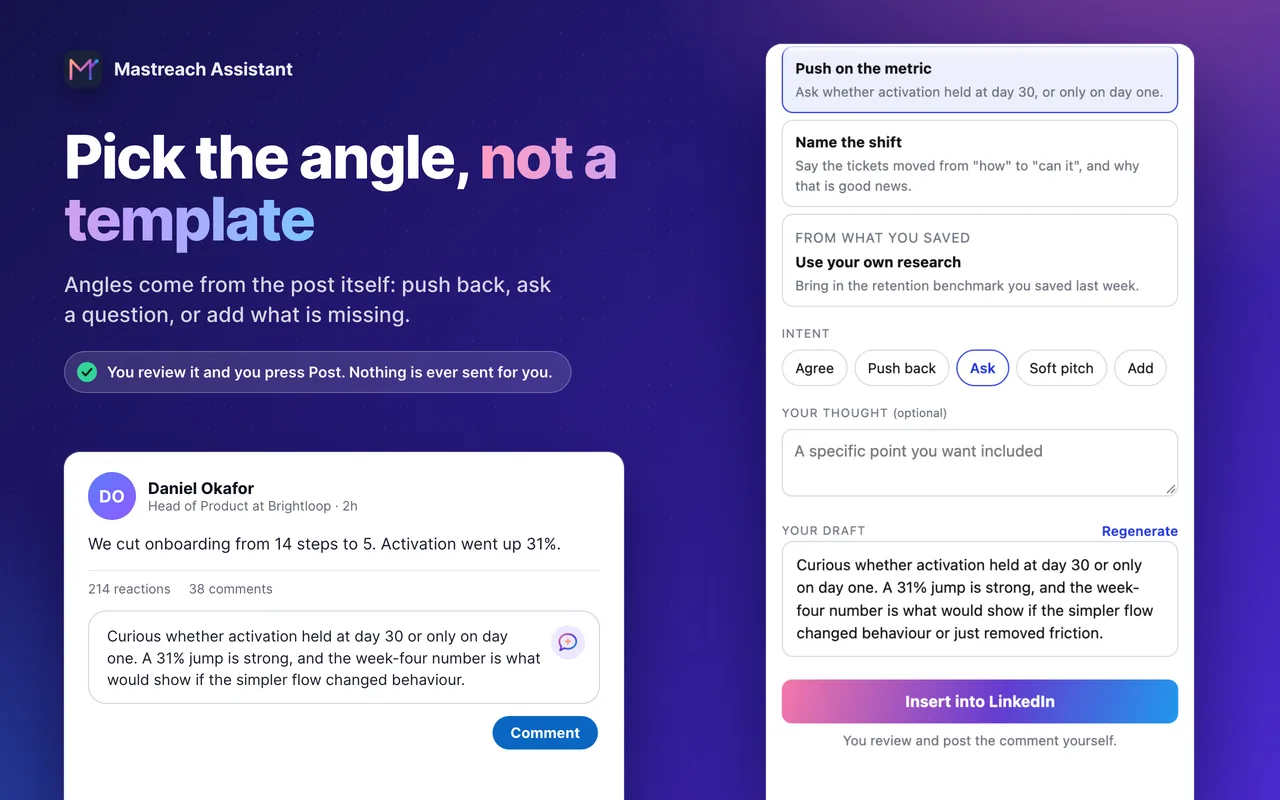
This is the approach Mastreach is built on. It finds posts worth commenting on in your subject and drafts a comment from your own knowledge and voice. You read it, change it if needed, and post it yourself. Nothing is posted automatically.
In fairness, Mastreach is a third-party tool too, and LinkedIn has not published which tools it counts as unauthorized. Our line is the one above: it never posts, comments or messages for you, and every comment is read and sent by a person. For more on what the 2026 feed rewards, see LinkedIn algorithm 2026: what changed.
Where Mastreach fits
If pods and auto-comment tools are out, you still need a way to comment well and often without it eating your week. That is the gap Mastreach fills, by doing the slow parts and leaving the posting to you.
- Finding: it shows you posts in your subject that your buyers are reading, instead of a pod's random list.
- Drafting: it suggests angles from the post and drafts a comment in your voice from your own knowledge.
- Posting: you read it, change it and post it yourself. It never posts, comments or messages for you.
It also adds up the impressions your comments earn, so you can see real reach rather than pod likes. There is a 5-day free trial.
FAQ
Are LinkedIn engagement pods against the rules?
LinkedIn said in March 2026 that it is taking action to stop engagement pods, along with comment automation and unauthorized third-party tools, as behaviour that promotes inauthentic engagement.
Can LinkedIn detect engagement pods?
LinkedIn does not publish how it detects them. Pods do produce a recognisable pattern: the same accounts commenting quickly on every post.
Is it safe to use an auto-comment tool on LinkedIn?
LinkedIn has named comment automation and unauthorized third-party tools as behaviour it is acting against. Beyond that, an automated comment carries your name and reputation without you having read the post.
Can I use AI to draft LinkedIn comments?
Using AI to help you write is different from automation. If you read the post, decide to comment, review the draft and post it yourself, at a human pace, you remain the author of every comment.
Sources
See what your own comments are reaching.
Mastreach finds the LinkedIn posts your buyers are reading, drafts a comment in your voice, and counts the impressions LinkedIn never adds up for you. You post every comment yourself.
- 914 comments drafted with Mastreach and posted by their owners
- 177,931 LinkedIn impressions on those comments, August to September 2026