LinkedIn AI slop detection: will your comments be flagged?
LinkedIn now checks posts shown beyond your network for AI slop, at 94% precision. What it means for comments, plus a 4-point test before you post.

Part of our LinkedIn comments guide: where to comment, what to write, and how to measure what it earns.
Does LinkedIn's new AI slop detection catch comments written with AI? LinkedIn has not said that. On 8 October 2026 it said its detection now covers all posts shown beyond your immediate network, with 94% precision, and it says elsewhere that it acts on comments that only restate a post. The safe rule is simple: use AI for a first draft if you like, then add one fact from your own work and post it yourself.
What did LinkedIn say about detecting AI slop on 8 October?
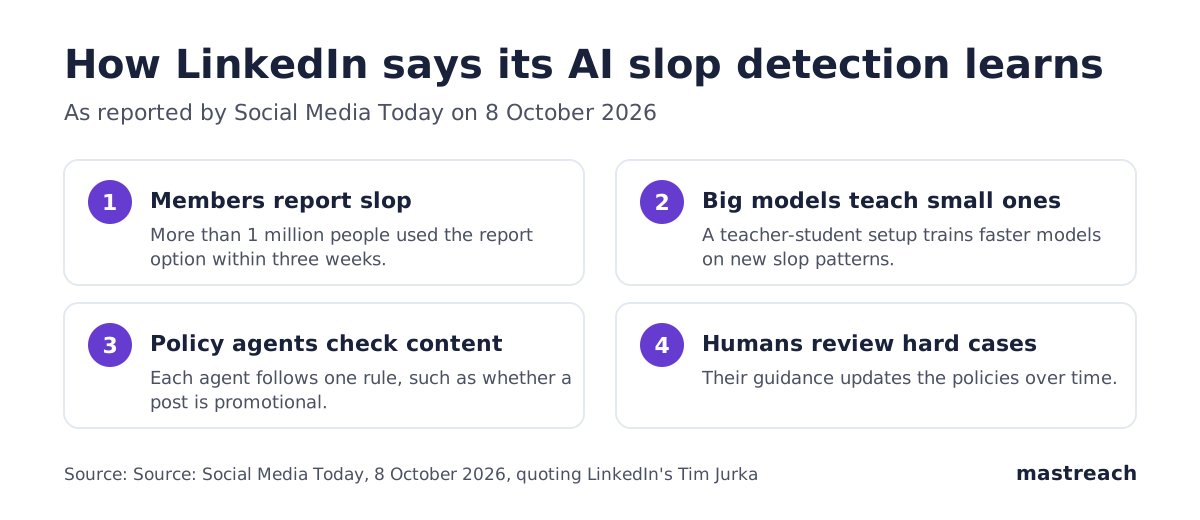
LinkedIn's VP of Engineering, Tim Jurka, shared more detail on how the company finds "AI slop". LinkedIn defines this as generic or repetitive content that adds no real insight. We could not open his original LinkedIn post, so what follows comes from Social Media Today's report, which quotes him.
Three points stand out:
- Reports teach the system. LinkedIn added a button in August to report suspected AI slop. Per the report, more than 1 million people used it in under three weeks, and those reports help train the detection.
- Big models teach small ones. Jurka described a "teacher-student setup": larger models spot new slop patterns, and that trains smaller, faster models.
- Rule-following agents, with people checking. Each AI agent follows one policy, such as whether a post is promotional. Hard cases go to human reviewers, and the policy is updated from their guidance.
The headline claim: the classifiers now cover "all posts that are distributed beyond your immediate network," at 94% precision. LinkedIn also previously reported a 40% drop in views of AI slop, as relayed by the same outlet.
Does the 94% figure apply to comments or only posts?
As worded, it applies to posts. The quote says posts, and we have found no LinkedIn statement that the 94% figure covers individual comments.
Also read "precision" carefully. It usually means that when the system flags something as slop, it is right 94% of the time. It does not tell you how much slop it misses, and LinkedIn has not shared the test details. An earlier LinkedIn announcement used a similar number, 94%, for "initial testing" of generic content, so treat it as LinkedIn's own measure.
What LinkedIn has said about comments is in that same announcement. It says it will recognise and act on "comments members create and post at scale using automation tools, with little or no human involvement" and on "responses that simply restate the original post". We cover that in detail in our article on AI slop comments.
So we know the rule for comments, and we know the detection for posts is strong. We do not know how a single comment is scored. Anyone who tells you they do is guessing.
Does LinkedIn mind if I use AI to help write comments?
No, as long as the comment is really yours. LinkedIn's wording is: "It's ok to use AI to help you write." It adds that posts and comments "need to represent your voice and your perspectives."
Jurka said something similar in an August 2026 podcast interview. He said members should use AI tools to bring authentic, original perspectives, and that repetitive content made through automation is "a no-go" for LinkedIn.
The line LinkedIn draws is not between AI and no AI. It is between a person with something to say and a machine filling space.
How does LinkedIn tell slop from useful AI-assisted writing?
It does not publish the full list, but its description gives clues. Slop is content that "sounds polished" yet has no real perspective. Useful content adds "perspective, context, or expertise".
One practitioner view, from AJ Wilcox in Social Media Examiner, is that readers react to emptiness, not polish. He also thinks reports currently train the system rather than penalise people directly. That is one expert's opinion, not a LinkedIn rule.
Our reading is practical. A reader, a human reviewer or a model all face the same question: does this text contain something that could only come from this person? Three tells usually answer it:
- It could sit under a hundred other posts without changing a word.
- It repeats the post in different words.
- It has no place, number, name, story or opinion in it.
Why do generic AI comments get buried anyway?
Even if LinkedIn never flags them, readers ignore them. In Wilcox's view, flagged AI comments get few likes and replies, so ordinary engagement pushes them down. A comment that nobody answers rarely helps you.
There is a second cost. Your comment is a small sample of how you think, and a founder, coach or consultant is judged on it. A US agency owner who leaves "Great insights!" under a buyer's post has spent the effort and gained nothing. A UK consultant who leaves one sentence about a real client problem gets a reply.
This matches what we see in our data. Across 914 comments drafted in Mastreach and then posted by their owners, LinkedIn reported 177,931 impressions, about 195 per comment. Impressions are not unique people, since repeat views and your own views count, and we have no post-impression comparison for these accounts. What the data does show is that where a comment sits matters a great deal (see what 914 comments earned). A strong comment under a quiet post is seen by few people.
What makes a drafted comment yours? A four-point test
Run this before you post any comment, whether you wrote it alone or started from a draft.
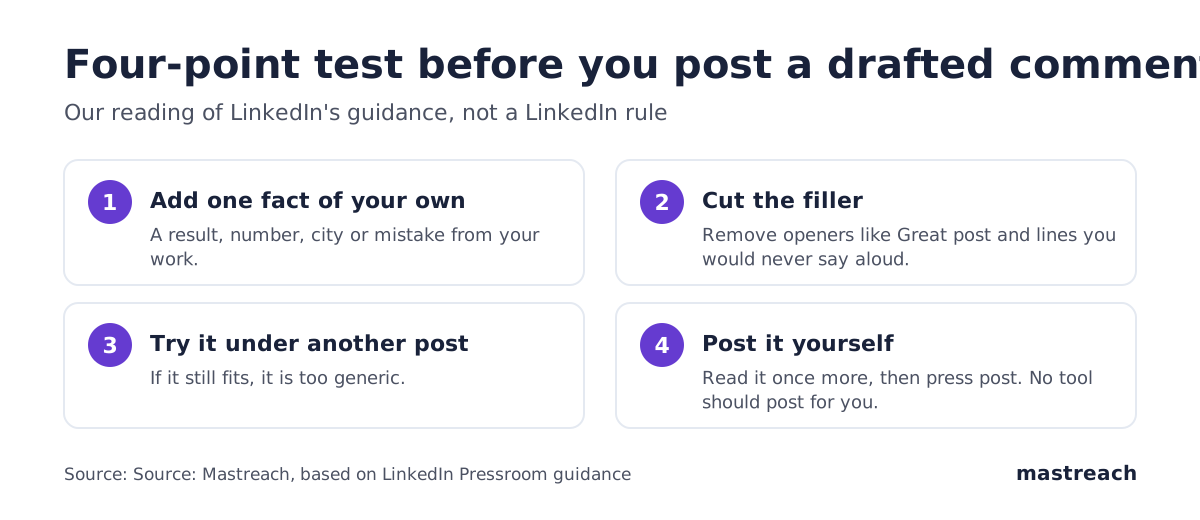
1. Does it hold one fact from your own work? A client result, a number, a city, a mistake. One is enough. A Dubai property adviser might write: "We saw the same with a Marina client, three viewings booked after one clear price guide."
2. Have you removed the filler? Delete "Great post", "Thanks for sharing" and any dramatic line you would never say aloud.
3. Could it fit under a different post? Paste it in your mind under another post. If it still works, it is generic.
4. Will you post it yourself? Read it once more, then press post. This is the step LinkedIn's wording about "little or no human involvement" points at.

Is it safe to use a tool to draft LinkedIn comments?
Drafting is different from posting. A tool that writes a draft you read, edit and post is a writing aid. A tool that posts for you is automation, which LinkedIn has said it is acting against (more in our article on engagement pods and auto-comment tools).
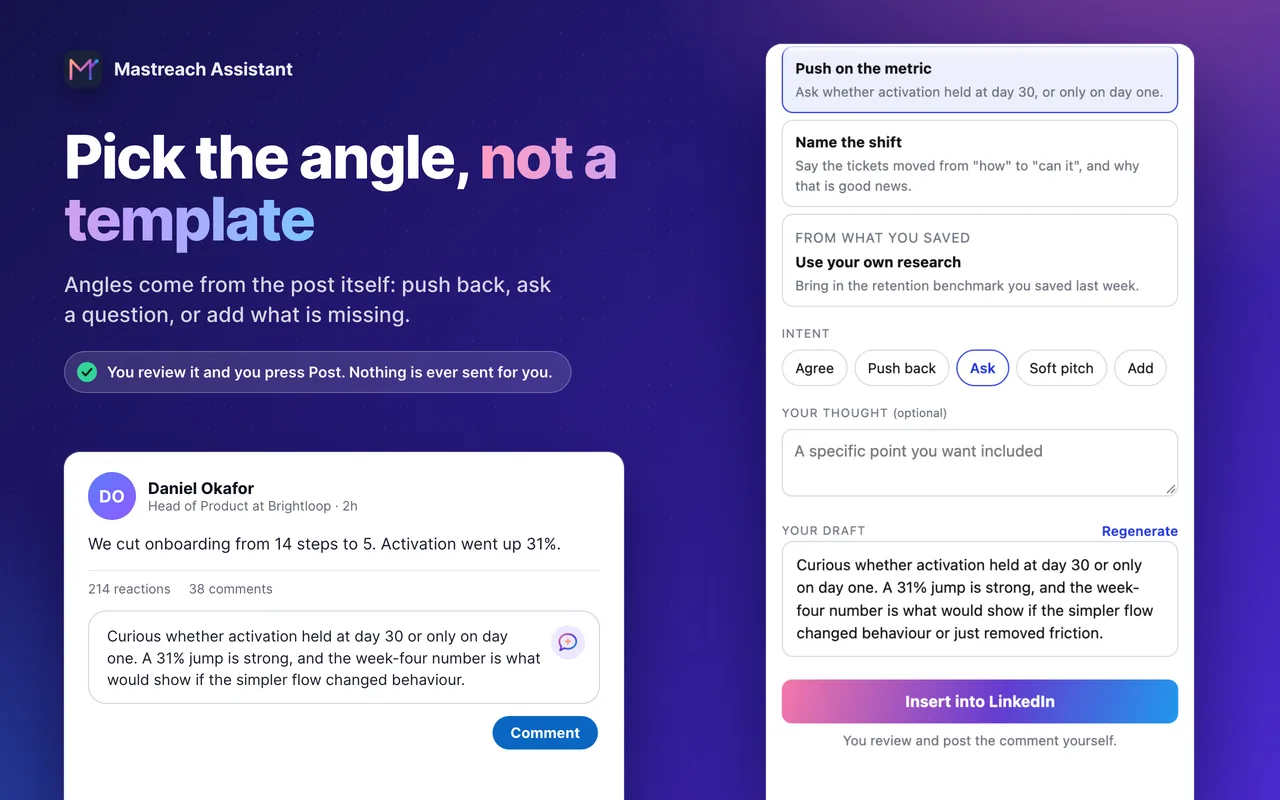
Mastreach is built on that difference. It finds the LinkedIn posts your buyers are reading and drafts a comment in your voice. You edit it and post it yourself. It never posts, comments or messages on your behalf. We designed it that way because we think the human step is also what makes the comment worth reading.
What should a founder or consultant do this week?
- Pick five posts where your buyers are reading, not five random ones.
- Write or edit one comment per post that holds one real fact from your work.
- Check each comment impression a few days later. LinkedIn shows these one comment at a time (where to find them).
- Note which comments got replies. Do more of those.
- Do not chase volume. Five good comments beat twenty empty ones.

Where Mastreach fits
The four-point test above is easier to pass when the tool is built for it. In Mastreach:
- Angles, not templates. Each draft starts from something specific in the post, so it never just restates it.
- Your facts. Add a thought of your own before drafting, or let it draw on pages you saved, so the comment has a detail only you could add.
- Your hand on the button. You edit and post every comment yourself. Mastreach never posts, comments or messages for you.
It also counts the impressions your comments earn, so you can see what is being read. There is a 5-day free trial.
FAQ
Will LinkedIn penalise me for using AI to draft comments?
LinkedIn has not said so. It says using AI to help you write is fine, and that your words must carry your own voice. It is acting against automated comments with little human involvement, and against replies that only restate a post.
Does the 94% figure mean LinkedIn catches 94% of AI comments?
No. It is reported as precision on posts shown beyond your immediate network, which is about how often a flagged item is truly slop. It does not say how much slop is missed, and it is not stated for comments.
Can readers report my comment as AI slop?
LinkedIn added an option to report suspected AI slop in August 2026. The report helps train its systems. LinkedIn has not said a report removes a comment on its own, so treat any firm claim as unconfirmed.
How do I make an AI draft sound like me?
Add one real detail from your work, cut the filler openers, and read it aloud once. If you would not say a sentence to a client, change it. Then post it yourself.
Sources
- LinkedIn exec offers insight into the battle against AI slop (Social Media Today, 8 October 2026)
- Keeping conversations real on LinkedIn (LinkedIn Pressroom)
- How to Use AI on LinkedIn While Sounding Human (Social Media Examiner)
- Software Engineering Daily, episode 1949 transcript with Tim Jurka (LinkedIn)
See what your own comments are reaching.
Mastreach finds the LinkedIn posts your buyers are reading, drafts a comment in your voice, and counts the impressions LinkedIn never adds up for you. You post every comment yourself.
- 914 comments drafted with Mastreach and posted by their owners
- 177,931 LinkedIn impressions on those comments, August to September 2026