Are LinkedIn posts cited by ChatGPT? What studies show
Do LinkedIn posts show up in ChatGPT answers? Studies disagree. Here is the honest reading and a light weekly routine for consultants and founders.

Yes, LinkedIn posts are cited in ChatGPT and Google AI answers, but not as often as some headlines say. One study finds LinkedIn in under 1% of ChatGPT answers on common queries. Another finds it in 11% of AI responses across three AI tools.
Both can be true. They measured different things. For a consultant or founder, the useful question is not "how often?" but "what kind of post gets quoted, and what should I do about it?"
Does LinkedIn show up in ChatGPT and Google AI answers?
Sometimes. It depends on the tool and on the question asked.
A new SE Ranking study looked at 100,000 keywords. Social Media Today reports that links to social platforms appeared in 67.66% of Google AI Overviews, 32.39% of Google AI Mode replies and 8.4% of ChatGPT answers.
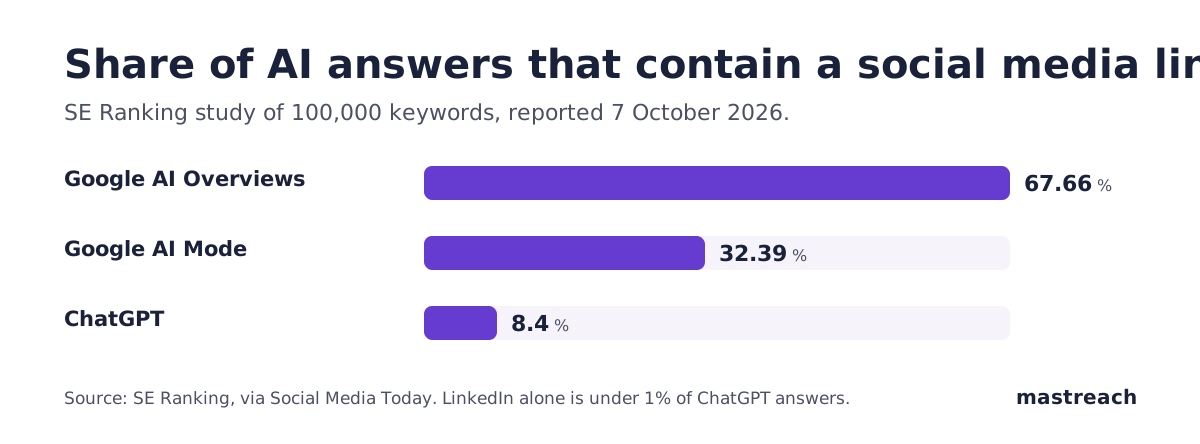
The same report says Reddit, LinkedIn and Facebook each appear in fewer than 1% of ChatGPT answers to common queries. So for ChatGPT, social media is not a big factor on those queries.
That is the cautious end of the evidence.
Why do the studies disagree on how often LinkedIn is cited?
They used different questions, different tools and different counting.
Semrush studied 325,000 prompts across ChatGPT Search, Google AI Mode and Perplexity. In its report, LinkedIn ranked second among cited domains, appearing in 11% of responses on average. That figure was 14.3% on ChatGPT Search, 13.5% on Google AI Mode and 5.3% on Perplexity. Most prompts came from business topics such as technology, business services and finance.
SE Ranking used brand-related keywords across many niches. Semrush used professional prompts, where LinkedIn is naturally more relevant. Semrush also says it worked with LinkedIn on part of the data. Both are software vendors, and neither study is peer reviewed.
Our reading: if your buyers ask business questions, LinkedIn matters more to them than the lowest number suggests. If they ask about everyday products, much less. Neither study can tell you what your buyers ask.
Which LinkedIn posts do AI assistants actually cite?
Posts that teach something. According to the Semrush study, between 54% and 64% of cited posts shared knowledge or practical advice. About 95% of cited posts were original, and reshares made up only 5%.
Length matters a little. Semrush found that mid-length posts of 50 to 299 words were cited most among feed posts. Long articles of 500 to 2,000 words were cited most among articles.
Three things stand out for a busy consultant:
- Original beats shared. Your own view, your own example.
- Useful beats clever. A clear answer to a buyer's question.
- Plain beats vague. Semrush advises stating your core message in the first lines and using precise terms for your category.
Here is how it might look. A UK tax adviser writes: "Most small firms overpay on VAT in their first year. Here are the three places we look." A Dubai logistics consultant explains how customs delays are priced into a contract. Both are specific, teachable and theirs.
Do you need a big following to be cited?
No, but consistency seems to help. Semrush found most cited posts had moderate engagement, around 15 to 25 reactions. About 75% of cited authors posted frequently, at least five posts in four weeks. Nearly half had over 2,000 followers, so more than half had fewer.
Semrush's own summary is that citations reward relevance and consistency more than virality. We agree with that reading. You do not need a viral post. You need a steady record on one subject, which is the same advice we gave in why your LinkedIn reach is low when you cover too many topics.
Does it help to post as a person, not a company?
Probably, for most small firms. Semrush found individuals made up 59% of LinkedIn citations on ChatGPT Search and Google AI Mode. On Perplexity, Company Pages made up 59%.
Oktopost, a social media software company, audited 63 B2B companies. It found that when AI tools quoted a named person, that person had published on LinkedIn 74% of the time. This is a small vendor audit, and Oktopost itself says it is not a published research study. We treat it as a direction, not a fact.
If you are a founder, coach or consultant, you are the brand. Your name on a post is the thing a buyer and a machine can both attach to.
How often should a consultant post to be quotable?
Aim for something you can keep up. One good teaching post a week is more useful than five rushed ones. That meets the "frequent" pattern in the Semrush data, which is a little over one post a week.

There is no promise here. Nobody outside the AI companies knows exactly why one post is chosen over another. These studies show patterns, not guarantees.
Can comments build the same authority?
Not in the same way, and we want to be careful here. We have no evidence that AI tools cite LinkedIn comments. What comments do is put your name and your view in front of the people reading a buyer's post.
In our data, 914 comments drafted in Mastreach and then posted earned 177,931 impressions, about 195 per comment. These are impressions as LinkedIn reports them. They are not unique people, repeat views and your own views count, and we have no comparison with posts for these accounts. Still, they show comments are read. We cover this in what 914 comments earned and in how comment impressions work.
Think of it as two jobs. Posts give you something to be quoted. Comments get you noticed by the right people. A tool such as Mastreach can find the posts your buyers read and draft a comment in your voice. You read, edit and post it yourself.
What should you do this month?
Keep it small. Here is a routine of about two hours a week.
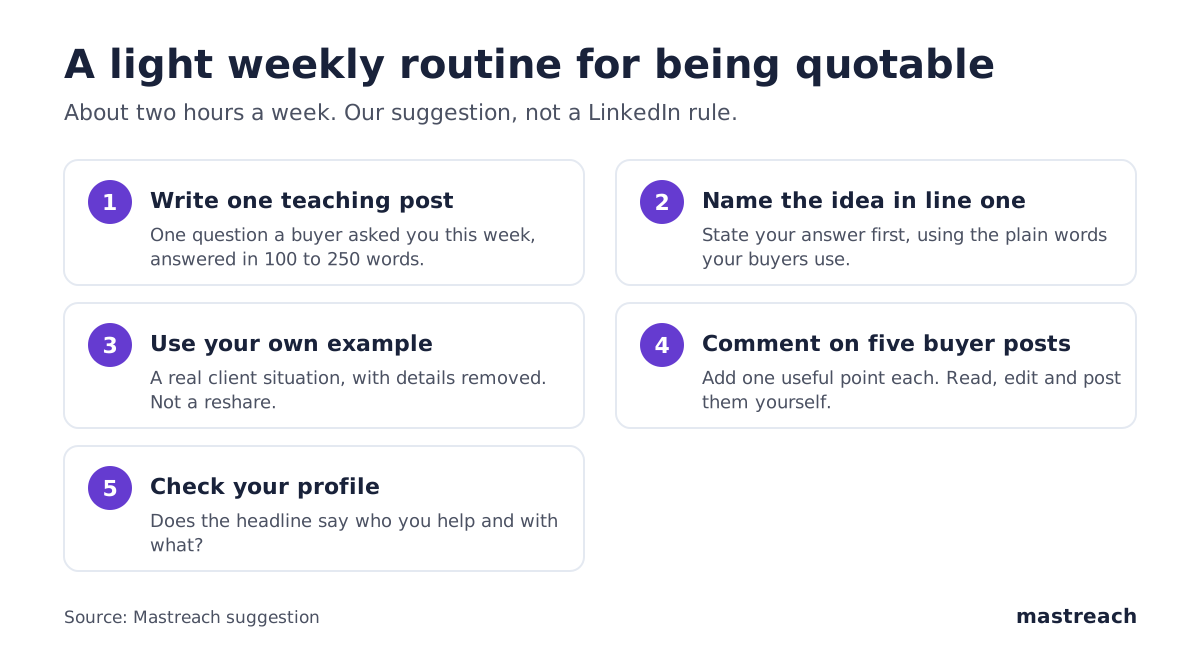
- Write one post a week that answers a question a buyer really asked you.
- Put the answer in the first line, in the words your buyers use.
- Use a real example from your work, with names removed.
- Comment usefully on a few posts your buyers read.
- Make sure your headline says who you help and with what.
Then wait. Do not expect results in a week. Check after eight to twelve weeks whether the right people mention your posts or ask you questions. Also try asking ChatGPT or Google a question your buyers would ask, and see what it says about your subject.
Where Mastreach fits
Being quotable starts with posts, but it grows in the conversation around them. Mastreach helps on both sides of that conversation:
- On other people's posts: it finds posts in your subject that your buyers read and drafts a comment in your voice.
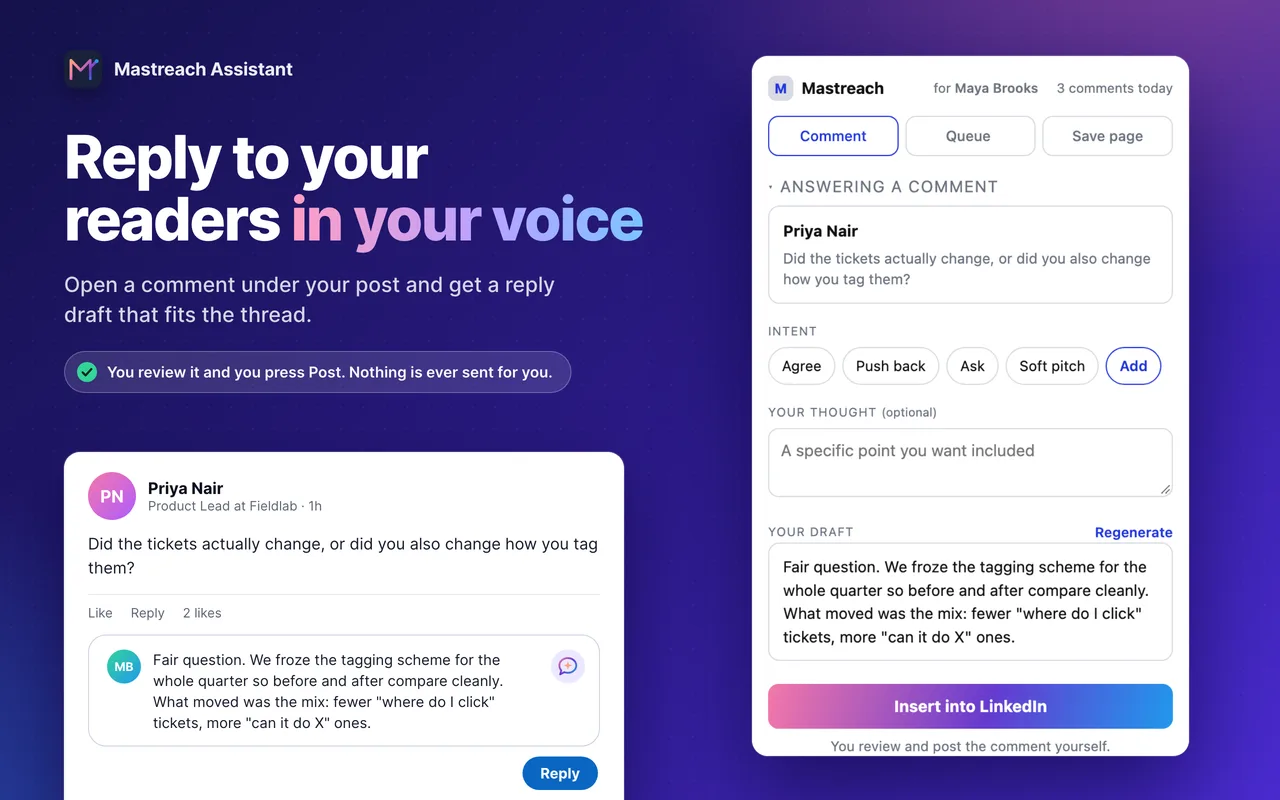
- On your own posts: open a reader's comment and get a reply draft that fits the thread, so good questions get good answers.
- From what you know: save the pages and notes behind your views, and drafts can draw on them.
You edit and post everything yourself; nothing is sent for you. You can try it free for 5 days.
FAQ
Does ChatGPT cite LinkedIn posts?
Sometimes. SE Ranking found LinkedIn in under 1% of ChatGPT answers on common brand-related queries. Semrush found it in 14.3% of ChatGPT Search responses on professional prompts. The difference comes from what was asked.
What kind of LinkedIn post gets cited by AI?
Original posts that teach something useful. In the Semrush data, most cited posts shared knowledge or advice, and only about 5% were reshares. Clear first lines and plain wording also help.
Do I need thousands of followers to be cited?
No. Nearly half of cited authors in the Semrush study had over 2,000 followers, which means the rest had fewer. Most cited posts had moderate engagement, around 15 to 25 reactions.
Do LinkedIn comments get cited by AI?
We have not seen evidence that they do. Comments help in another way: they put your view in front of buyers who are reading the post. Treat posts as the quotable part and comments as the way to be seen.
Sources
See what your own comments are reaching.
Mastreach finds the LinkedIn posts your buyers are reading, drafts a comment in your voice, and counts the impressions LinkedIn never adds up for you. You post every comment yourself.
- 914 comments drafted with Mastreach and posted by their owners
- 177,931 LinkedIn impressions on those comments, August to September 2026