LinkedIn comment ranking: what 'top comment for you' means
LinkedIn now orders comments by relevance to each reader. What is known, what is not, and how founders and consultants should comment in response.

Part of our LinkedIn comments guide: where to comment, what to write, and how to measure what it earns.
What is LinkedIn's new comment ranking? LinkedIn now orders the comments under a post by how relevant they are to each reader, not in one fixed order for everyone. The same comment can sit at the top for one person and far down for another.
For a founder, coach or consultant, the lesson is calm and practical. A comment no longer wins by being early or long. It wins by being useful to the specific people you want to reach. Here is what is known, what is not, and what to do this week.
What changed in how LinkedIn orders comments?
In August 2026, the creator economy writer Lindsey Gamble reported on Threads that LinkedIn had announced a comment ranking update. Social Media Today summarised it: comments are shown "based on their relevance to each user".
LinkedIn will use signals such as professional interests, connections and engagement activity. The aim is to surface comments that matter personally to the reader.
In October, Social Media Examiner added a detail: a personalised label, "top comment for you", is replacing the generic "top comment" label. That article is an expert's opinion, so treat its tactics as advice, not as LinkedIn policy.
Why does the top comment now differ for each reader?
Think of a post about hiring. A US agency owner reads it and sees a comment from a fellow agency owner first. A UK recruiter, reading the same post, sees a comment from someone in recruitment first.
Neither reader is seeing a mistake. LinkedIn is matching the comment to the reader. Our reading: your comment does not compete with every comment on the post. It competes for the attention of readers who share your subject, your connections or your habits.
That is good news if you write for a clear group of buyers. It is bad news for generic remarks such as "Great post!", which are relevant to nobody in particular.

Does being first to comment still help?
LinkedIn has not said that timing no longer matters, and it has not said that it does. What it has said is that relevance to the reader is the new basis for ordering.
So our reading is that speed is a weaker bet than it was. A fast but shallow comment can land in the wrong place. A comment written an hour later, with a real detail your buyer recognises, has a better chance of being shown to the right people.
That does not mean you should wait days. Post comments while the conversation is still alive. Just do not rush to be first at the cost of saying something specific.
What kind of comment is likely to rank for your buyers?
LinkedIn has not published how it weighs its signals, so nobody outside the company can promise what ranks. What we can do is reason from the signals it names: professional interests, connections and engagement activity.
- Professional interests. A comment that uses the language of your buyer's field signals what it is about. Name the situation, not just the topic.
- Connections. Comments from people the reader already knows will likely count for more. Your own connections in your buyer's world help here, which is a reason to build them steadily.
- Engagement activity. Replies and likes from others tell the system that people found it worth reading. A comment that invites a reply, such as a short, honest question, tends to get one.
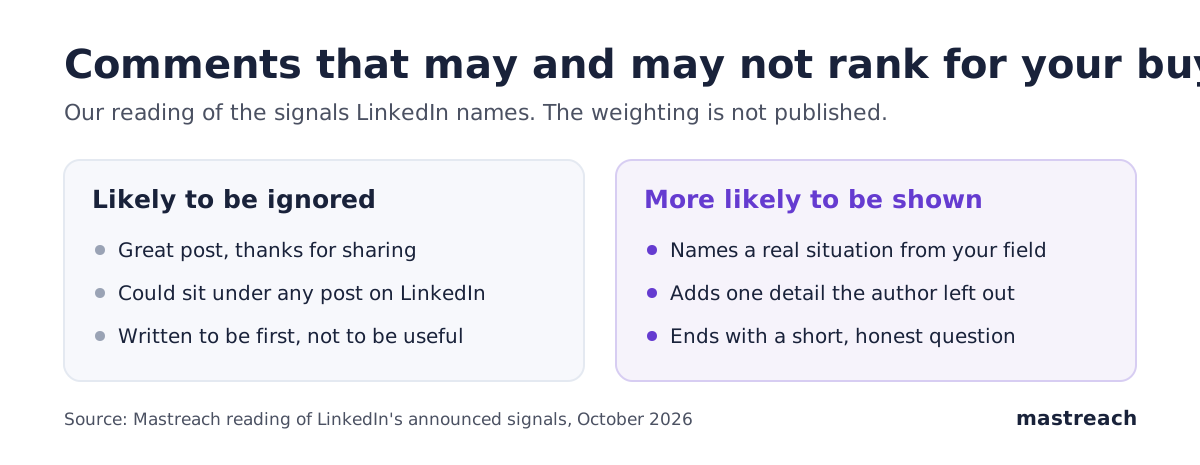
A simple test before you post: could this comment only have been written by someone who read this post and knows this field? If it could sit under any post, rewrite it. Our article on what makes a comment look like AI slop has a longer checklist.
Which posts are worth your comment time?
If relevance decides who sees you, then the post matters as much as the words. A comment under a post your buyers never read reaches the wrong people, however good it is.
Pick posts like this:
- Written by people your buyers follow. A Dubai property investor might read a handful of local advisers. Find those.
- On a problem you solve. One clear subject is easier for readers to link to you. We cover why in why LinkedIn reach is low when you cover too many topics.
- Active, not finished. Choose posts that are still collecting replies.
Spend your time on five or ten good posts a day, not fifty. Fewer, better comments are easier to keep specific, and they keep you from sounding like the automated comments LinkedIn is trying to push down. The same Social Media Today article notes that LinkedIn is also cracking down on engagement pods and AI spam in comment sections.
How do you check that your comments are being seen?
LinkedIn shows the impression count under each of your comments, one comment at a time. It does not add them up anywhere. If you want to learn what works, you have to record them yourself. Our guide to finding your LinkedIn comment impressions shows where to look.
Here is a simple weekly routine, ten minutes on a Friday:
- Open your recent comments and note the impression count for each.
- Write the author and subject next to each number.
- Mark the three highest and the three lowest.
- Ask what the best three have in common: the author, the subject, the kind of detail.
- Do more of that next week.
Remember what impressions are. They are not unique people, and repeat views, including your own, are counted. They show reach, not clients. They are still the best signal you have that a comment was shown at all.
Our own numbers give a rough sense of scale. From August to September 2026, 914 comments drafted in Mastreach and then posted earned 177,931 impressions as LinkedIn reports them, about 195 per comment. We have no comparison with the same accounts before, so this shows reach, not cause. Results also varied widely between accounts.
What has LinkedIn not told us yet?
Quite a lot. As of October 13, 2026, we could not find a detailed LinkedIn newsroom post on this change. The main report is the one relayed by Social Media Today. LinkedIn has not told us:
- how much each signal counts;
- whether the rollout has reached every country;
- whether a reply to a comment is ranked the same way as a top-level comment;
- how the change treats comments it suspects are AI-generated.
On that last point, Social Media Today cites an estimate from the AI detection firm Pangram Labs, based on 57,000 public posts, that 30% of comments between April and June were fully AI-generated. That is one firm's estimate, not LinkedIn's figure. Treat it as a reason to write comments that sound like a person, not as a fact about your feed.
Where Mastreach fits
Ranking by relevance rewards two things that are hard to keep up by hand: choosing the right posts, and writing a specific comment each time. Mastreach is built for that work.
- It shows posts in your subject that your buyers are reading.
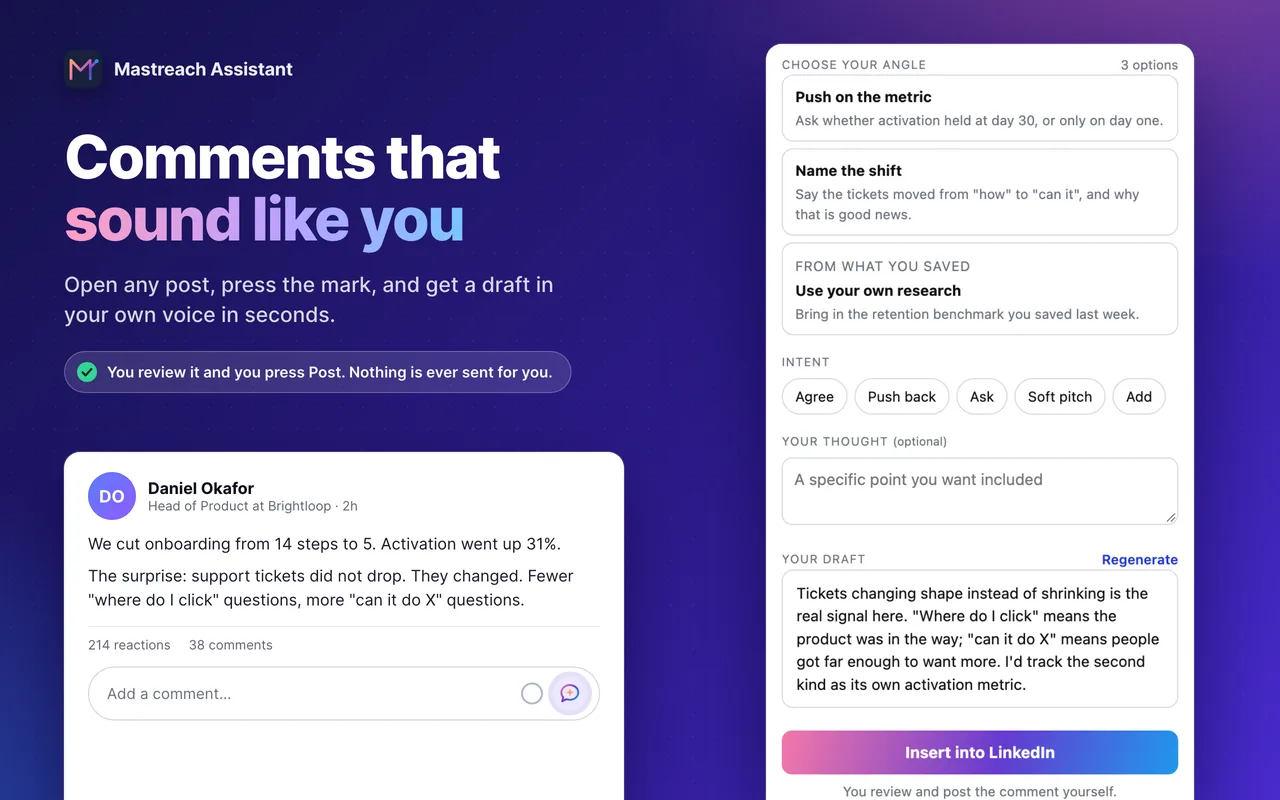
- On any post, you pick an angle drawn from the post and get a draft in your own voice.
- It records the impressions LinkedIn shows under each comment and adds them up by week, so you can see which posts and authors bring reach.
You read, edit and post every comment yourself. Mastreach never posts, comments or messages for you.
There is a 5-day free trial.
FAQ
Does LinkedIn show everyone the same top comment?
No. LinkedIn has announced that comments are ranked by relevance to each reader, so the order can differ from person to person. The details of how it decides have not been published.
Is the first comment still the best one?
LinkedIn has not said so. Because relevance to the reader is now the stated basis, our reading is that a specific comment posted a little later can do better than a shallow one posted first.
Can I see how many people saw my comment?
You can see the impression count LinkedIn shows under each of your comments. It is one number per comment and it counts views, not unique people. LinkedIn does not total them, so you need to record them yourself.
Should I use AI to write my comments?
You can use it as a drafting aid, but the comment has to be yours: your view, your detail, your words. Edit it and post it yourself. Generic comments are the ones most likely to be ignored.
Sources
See what your own comments are reaching.
Mastreach finds the LinkedIn posts your buyers are reading, drafts a comment in your voice, and counts the impressions LinkedIn never adds up for you. You post every comment yourself.
- 914 comments drafted with Mastreach and posted by their owners
- 177,931 LinkedIn impressions on those comments, August to September 2026