LinkedIn Creator Discovery: what it means for you
LinkedIn now lets brands filter creators by industry and job function. What it is, who can use it, and how a small consultant can be easy to find.
LinkedIn Creator Discovery is a new beta tool that helps brands find creators by industry, job function, audience and content type. It is built for advertisers, so most consultants cannot use it directly, but it shows what LinkedIn thinks buyers trust: specific expertise from real practitioners.
If you are a founder, coach or consultant, the useful question is not "How do I get into this programme?" It is "Would a stranger know, in ten seconds, what I am an expert in?" This article explains what LinkedIn announced, what is still unclear, and what to do about it this week.
What is LinkedIn Creator Discovery?
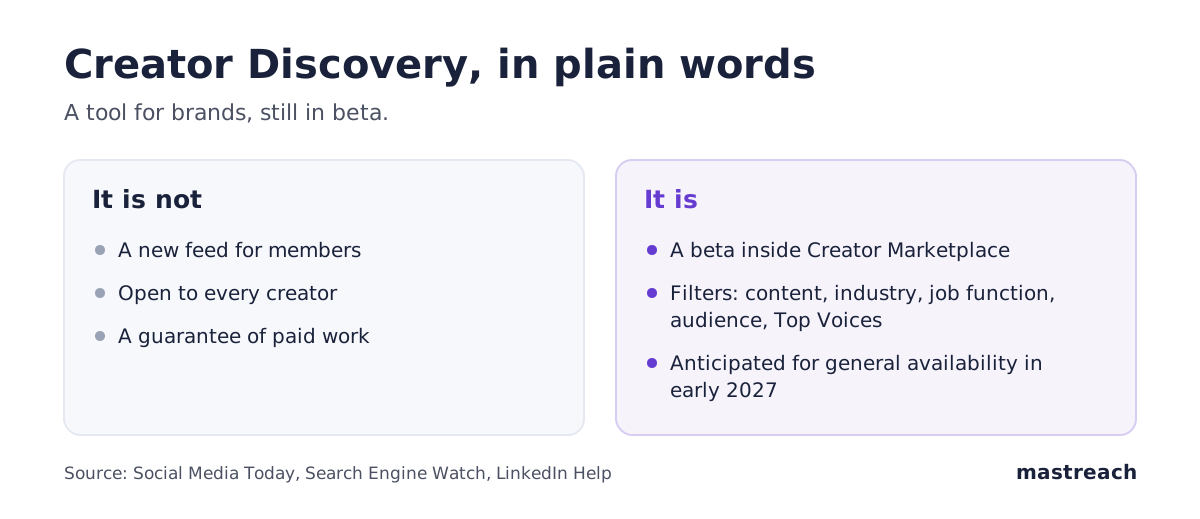
Creator Discovery is a beta inside LinkedIn's Creator Marketplace, a tool for brands that run campaigns. According to Social Media Today, LinkedIn describes it as introducing "new search filters, including content type, creator industry and job function, audience demographics, and Top Voices."
In plain words: a marketing team can now narrow a long list of creators to the few who fit. A software company that wants to reach IT directors can filter by industry and job function, then read the content before it makes contact.
LinkedIn says general availability is "anticipated in early 2027." That is a target, not a promise. Reports differ on the exact beta date (we have seen September 28 and September 30), which is a good reminder that this is early news.
Do 63% of B2B buyers really rely on creators?
LinkedIn says so. The figure, reported by Social Media Today, is that 63% of B2B buyers rely on creators for research and insights early in their buying process, "per LinkedIn."
Treat it as a marketing claim. LinkedIn sells advertising around creators, and we have not seen the survey behind the number. It may well be directionally right. Buyers do look for practitioners before they talk to a vendor. But one company's figure is not independent proof.
The same goes for the ad results LinkedIn quotes. Search Engine Watch notes that these are "LinkedIn's own reported results, not independent measurements."
What we can say with more confidence is the direction of travel. LinkedIn's own statement, quoted by Social Media Today, is that buyers "want validation from credible subject matter experts and practitioners with real experience." That is good news for a consultant with ten years of hands-on work and no huge following.
Can a small consultant use Creator Discovery?
Probably not yet, and not directly. Brands use the tool. Creators appear in it only if they are in the Creator Marketplace.
LinkedIn's Creator Marketplace help page says the feature is "currently only available to a select group of members in the US and Canada." It lists eligibility signals including 12 posts in the last 90 days, 5,000 followers, 45,000 impressions in the last 90 days, and an invitation. It also says thresholds "may change over time."
If you are in the UK, the EU, Australia, the Gulf or India, you cannot use it today. If you are in North America and below those numbers, you cannot either. And meeting the numbers does not guarantee access, because the programme is by invitation. If it is open to you, the help page says a Monetization tab will appear in your Analytics Dashboard. If you do not see one, it is not available to your account.
Search Engine Watch adds that the filters "do not remove the need for human vetting." A person still reads the profile.
Do you need a Top Voices badge to be found?
For this particular tool, Top Voices is one filter among five. It is not a requirement. A brand can filter by industry and job function without it. LinkedIn has not published how often brands will use each filter, so we cannot tell you which matters most.
Our reading: the filters tell you what a buyer-side person will look for. Industry. Job function. Subject. Audience. None of these needs a badge. All of them need clarity.
How would a brand see you?
Imagine a marketer in Dubai, Chicago or London searching for someone who explains payroll compliance to mid-sized manufacturers. They land on your profile and your recent public activity. What do they see?
Ask yourself three plain questions:
- Can they tell your industry? "Helping businesses grow" tells nobody anything. "Payroll compliance for manufacturers in the Gulf" does.
- Can they tell your role? Founder, adviser, trainer, former finance director. Say it.
- Do your last ten pieces of activity agree with that? If your posts and comments cover five different subjects, the profile and the activity disagree. We wrote about this in why reach is low when you cover too many topics.

How can you look like a credible expert this week?
You do not need a new strategy. You need a short list, done once.
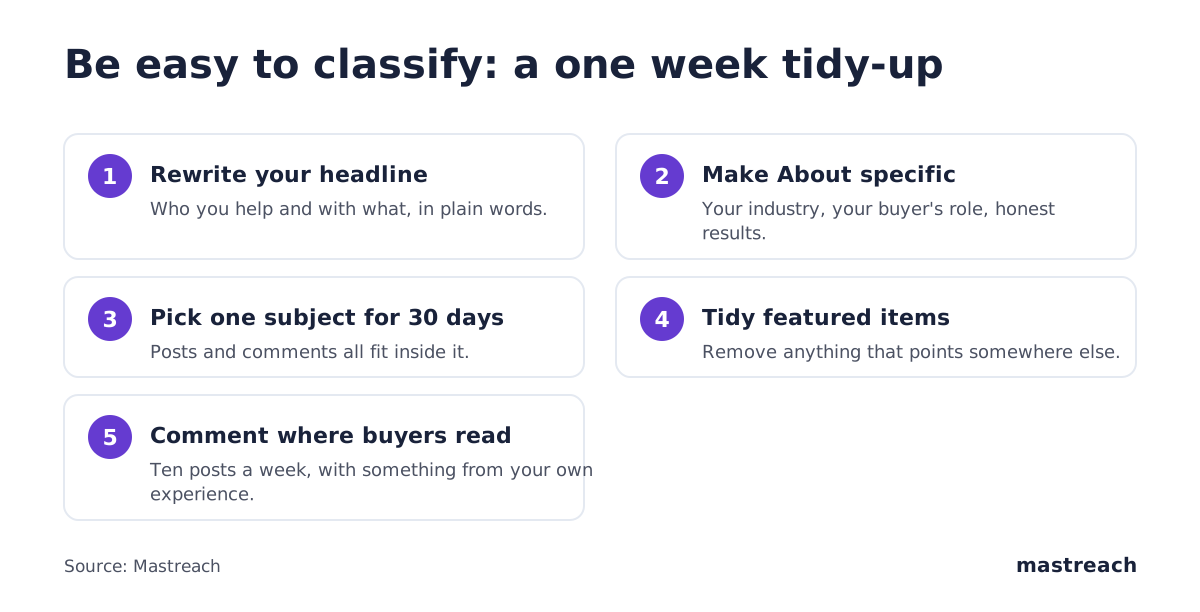
Step 1: Rewrite your headline. Use plain words: who you help and with what. A US agency owner might write "Helping B2B software firms get meetings from LinkedIn." A UK consultant might write "Pension advice for owner-managed companies."
Step 2: Make your About section specific. Name your industry, the role of your buyer and two or three results you can state honestly.
Step 3: Pick the subject for your next thirty days. One subject. Everything you post or comment on should fit inside it.
Step 4: Clean up what is pinned and featured. Remove old items that point somewhere else.
Step 5: Comment where your buyers read. Find ten posts a week by people your buyers follow, and add something useful from your own experience.
Why are comments a quiet way to show expertise?
A post says what you want to say. A comment shows how you think when someone else raises a question. For a busy buyer, that is often more convincing.
Comments are also public, specific and searchable by anyone who opens your activity page. They are also something you can do in ten minutes a day, without a following.
Here is what we have measured. Between August and September 2026, 914 comments drafted in Mastreach and then posted earned 177,931 impressions on LinkedIn, about 195 per comment. Our founder's own account wrote 284 of them over two months, earned 74,888 impressions, and grew from 1,391 to 1,585 followers in the same period.
Please read those numbers with care. Impressions are not unique people, because repeat views and your own views count. We have no before and after comparison for these accounts. Follower data exists only for the founder's account. None of this shows that comments win clients. It shows that comments are seen. You can read the full breakdown in what 914 comments earned, and learn where LinkedIn shows your comment impressions.
If you want help finding the right posts and drafting comments in your own voice, Mastreach does that. You read, edit and post every comment yourself.
Is Creator Discovery available outside North America?
Not yet, as far as LinkedIn has said. The Creator Marketplace launched in June for selected brands and creators in North America with English content, according to Search Engine Watch. LinkedIn expects wider availability of Creator Discovery in early 2027, but has not given a firm date or list of countries.
Our advice does not depend on that. A clear profile and focused comments help whether or not you are ever in a marketplace.
Where Mastreach fits
Creator Discovery is for brands with ad budgets. For a consultant without a badge, the practical version is to be visibly useful where buyers already read. Mastreach helps with the steady part of that:
- It finds the posts in your subject that your buyers are reading.
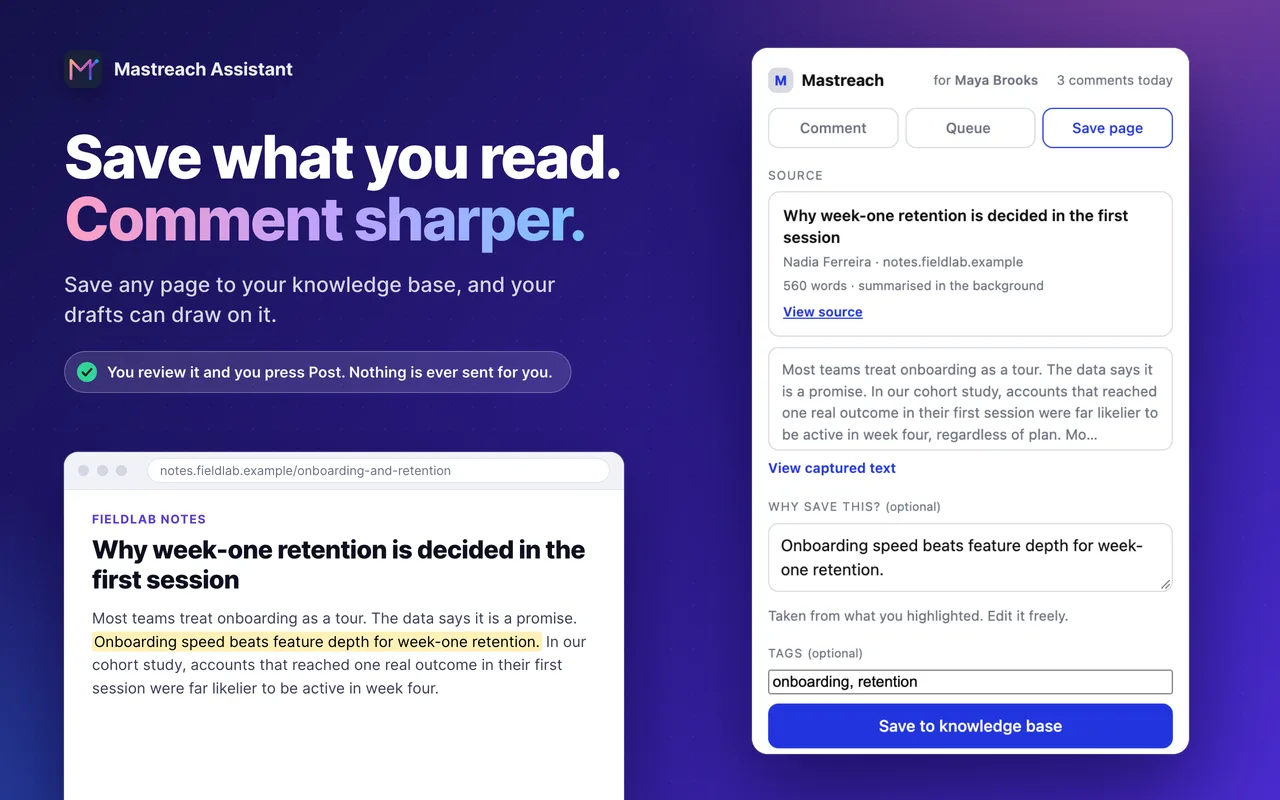
- It drafts from your expertise. Save the pages and notes that show what you know, and your comment drafts can use them.
- It measures the reach of your comments, which LinkedIn does not total for you.
You read, edit and post every comment yourself. You can try it free for 5 days.
FAQ
What is LinkedIn Creator Discovery?
It is a beta tool inside LinkedIn's Creator Marketplace for brands. It lets them filter creators by content type, industry, job function, audience demographics and Top Voices status. General availability is anticipated in early 2027.
Do I need to be a LinkedIn Top Voice to be found?
No. Top Voices is one of several filters, and a brand can search by industry and job function without it. Be clear about your subject and role.
Can I join the Creator Marketplace?
Only if LinkedIn has made it available to you. LinkedIn's help page says it is limited to a select group in the US and Canada, with signals such as 12 posts, 5,000 followers and 45,000 impressions in 90 days, plus an invitation. Check for a Monetization tab in your Analytics Dashboard.
Should I post more to get noticed by brands?
Not necessarily. A smaller amount of activity that clearly covers one subject is easier to understand than a lot of scattered posts. Our reading is that focus matters more than volume here.
Sources
See what your own comments are reaching.
Mastreach finds the LinkedIn posts your buyers are reading, drafts a comment in your voice, and counts the impressions LinkedIn never adds up for you. You post every comment yourself.
- 914 comments drafted with Mastreach and posted by their owners
- 177,931 LinkedIn impressions on those comments, August to September 2026